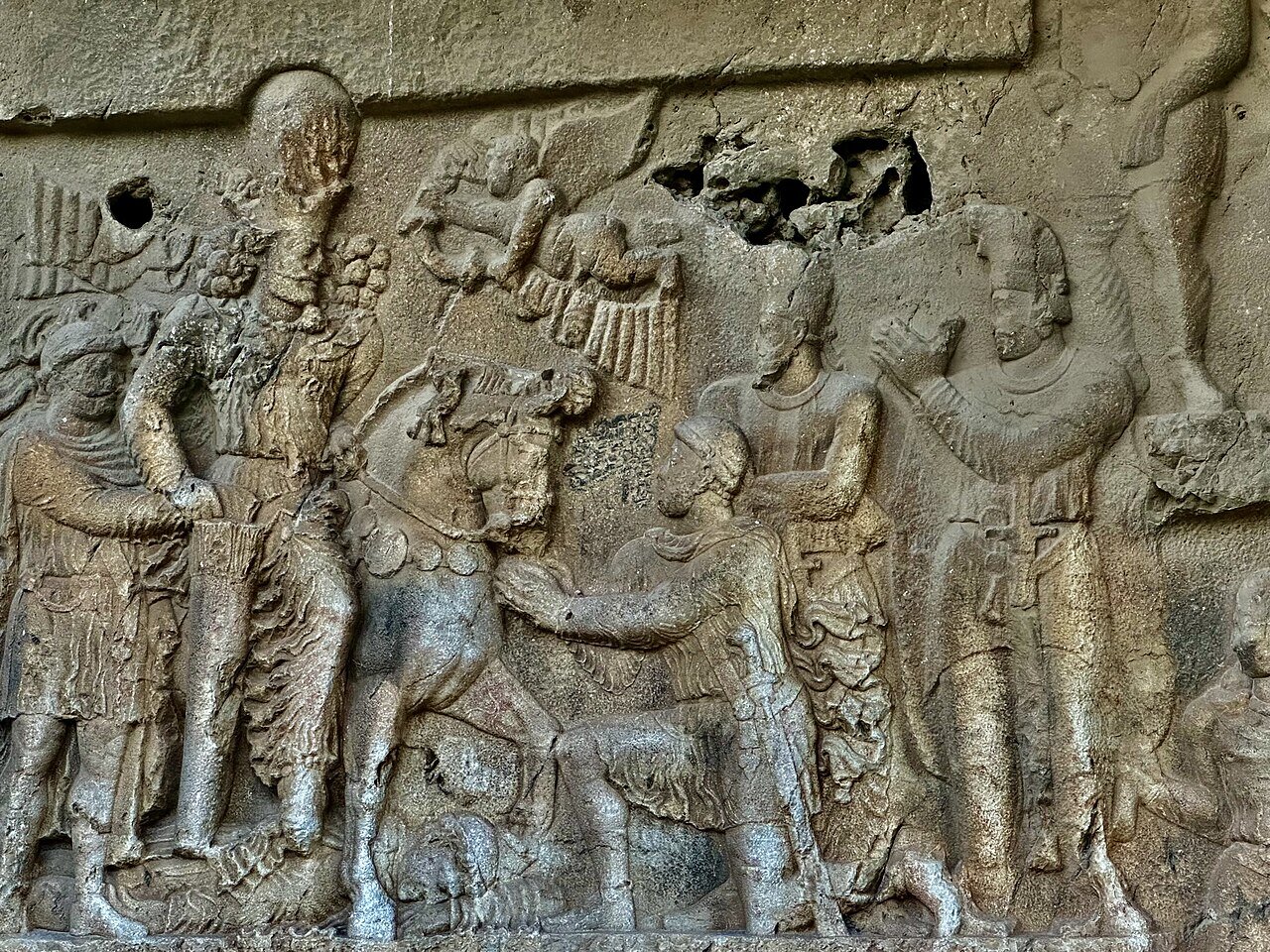
TEHRAN - Iran’s Fars province is stepping up efforts to promote the ancient Bishapur archaeological site and the nearby Tang-e Chogan gorge internationally, including plans to raise the profile of a historic relief depicting the capture of Roman Emperor Valerian by Sasanian King Shapur I.
The provincial Department of Cultural Heritage, Tourism and Handicrafts has also launched preparations for the conservation of Shapur I’s monumental statue, marking the first major restoration effort in about 80 years, its director general, Behzad Moridi, said.
Speaking to the Iranian Students’ News Agency (ISNA), Moridi said the department had increased its focus on Bishapur and Tang-e Chogan, near Kazerun, and was taking the promotion of the Valerian relief seriously.
He described the planned restoration of Shapur I’s statue as a significant undertaking, noting that the monument had not undergone restoration work for eight decades.
Moridi also said measures were being planned to create greater opportunities for introducing the Valerian historical relief to international audiences.
Also, another bas-relief at Naqsh-e Rostam, an Achaemenid necropolis near the UNESCO-listed Persepolis, depicts Shapur I’s victory over Roman emperors Valerian and Philip the Arab.
Valerian, who ruled the Roman Empire from 253 CE to 260, became the first Roman emperor captured by a foreign adversary on the battlefield when Shapur I defeated his forces at the Battle of Edessa in 260. The event was commemorated in Sasanian rock reliefs, including the monumental carving at Tang-e Chogan, which depicts Shapur triumphing over the Roman emperor.
Commenting on recent remarks by the US secretary of state concerning Iranian civilization, Moridi said historical discussions should not be turned into a confrontation between Iran and Greece.
He argued that the United States should not present itself as a representative of ancient Greek civilization, adding that discussions about the historical and cultural significance of Iran and Greece should be left to historians, philosophers and scholars of ancient civilizations.
Moridi acknowledged Greece’s important place in world history but said the two civilizations should be examined through their historical connections rather than an East-West rivalry.
Referring to the history of relations between the two countries, he said Iranian cultural influence had extended to Athens, arguing that Iran’s cultural legacy should not be reduced to military campaigns or violence.
Proposal to rename the Xerxes Canal as the Iran-Greece Friendship Canal
As an example of a more constructive approach to shared history, Moridi referred to a proposal reportedly made by the mayor of a town north of Athens, in an area associated with the Xerxes Canal and the birthplace of Aristotle.
According to Moridi, the mayor suggested renaming the approximately two-kilometer-long canal, built during the reign of Achaemenid King Xerxes I, the "Iran-Greece Friendship Canal."
Moridi also noted that Xerxes’ name appears at the entrance to the town, describing these references as indications of how Iranian historical figures are regarded in the area.
He said scholars and educators should emphasize historical and cultural connections instead of encouraging divisions between Eastern and Western civilizations.
While stressing that Greece’s profound historical and cultural significance should not be overlooked, Moridi questioned the relevance of US political figures commenting on a civilization with which, in his view, they have no direct historical connection.
The planned conservation of Shapur I’s monumental statue is part of broader efforts to strengthen the preservation and international recognition of the Sasanian heritage in Fars.
A separate conservation project at Shapur Cave, near Kazerun, has begun with scientific documentation, the preparation of protective scaffolding, plans to install a transparent barrier to prevent visitors from touching the monument, and the collection and preservation of detached fragments scattered around it.
The statue, carved from a single stalagmite, stands approximately seven meters tall, with shoulders about two meters wide and arms measuring around three meters.
Bishapur, Tang-e Chogan and Shapur Cave are among the major archaeological landmarks of the Sasanian era in southern Iran. The Sasanian Archaeological Landscape of Fars is inscribed on UNESCO’s World Heritage List.