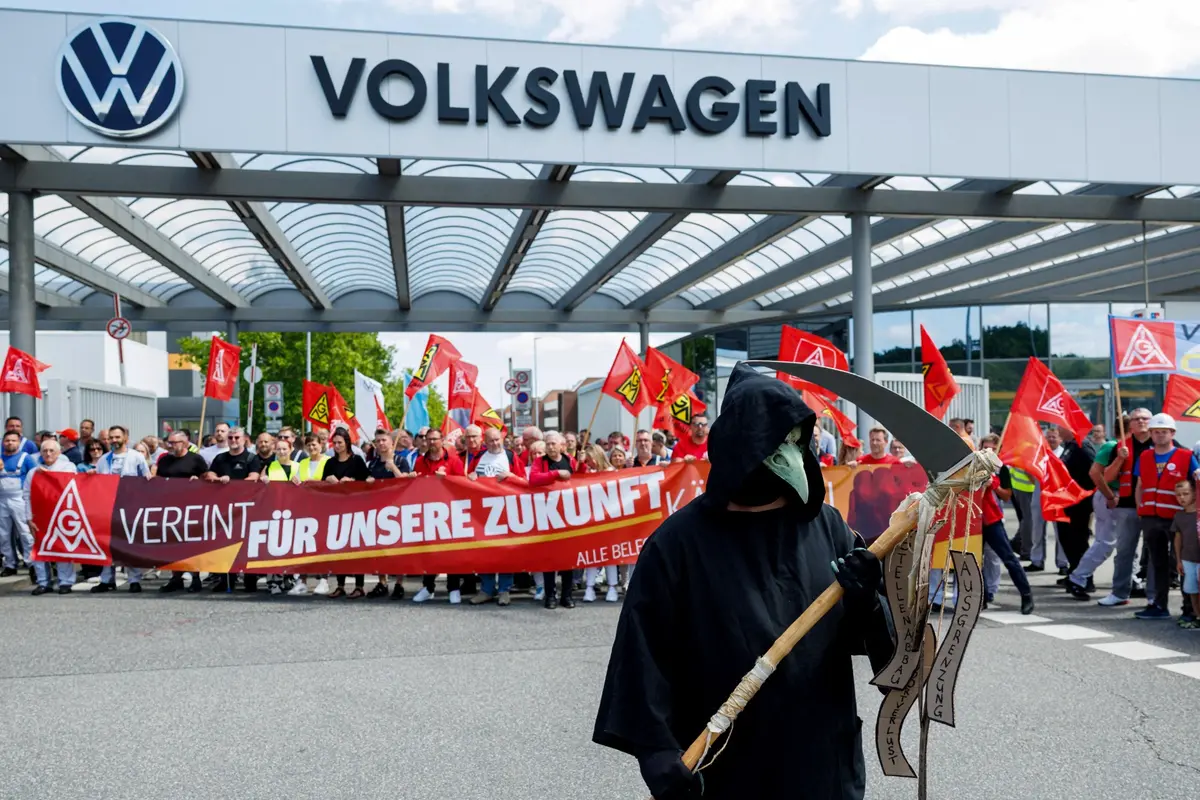
 A participant wearing a costume of the Grim Reaper stands in front of a Volkswagen (VW) plant during a rally by union workers against mass job cuts. (Photo by Jens SCHLÜTER / AFP)
Recent weeks and months have seen thousands of jobs cut across industries at a number of Germany's largest companies. Here's a roundup of the businesses reducing their workforces now.
Multiple large German firms have announced significant staff reductions in recent weeks.
The latest came Monday morning as communications giant Vodafone announced plans to cut nearly one out of five of its workers in Germany.
As for why they are downsizing, major manufacturers are pointing largely to fierce pricing competition with Chinese competitors while businesses in other sectors are looking to strengthen their numbers, and many companies suggest they will also be investing in, or increasing their use of, AI.
Of course, for the employees finding themselves threatened with job losses, what really matters is what their buyout or severance offer looks like and what options are available going forward.
Here's a roundup of the major job cuts that have been announced by German companies this fall – to be updated as further major cuts are announced. (A previous roundup of companies that announced major cuts closer to the start of the year can be found here.)
Don't miss our journalists' daily news roundup from Germany
An ongoing wave of significant job cuts continues to affect Germany's automotive and industrial sector.
Major reductions in the workforces at some of Germany's largest automakers, and automotive parts suppliers – many of which began toward the beginning of this year, or even earlier in 2025 – continue to be announced week after week.
Volkswagen: At the heart of it all is Germany's largest automaker, which is expected to cut up to around 100,000 jobs globally by 2030.
Of those, around 50,000 job losses were expected in Germany, spread among Volkswagen Group's various brands. Volkswagen Group owns 10 brands, including other German giants like Audi and Porsche.
Porsche, for example, announced over the summer that it would cut a further 5,000 jobs by 2035.
Audi had previously announced a reduction of roughly 7,500 workers by the end of 2029.
READ ALSO: Porsche rules out US production following Audi deal with Trump
BMW has also previously announced plans to cut 8,000 jobs by the end of 2027 via a voluntary reduction program.
At the end of October, Mercedes-Benz announced plans to restart a voluntary reduction program of its own.
Previously the company's CEO had expressed the goal of 30,000 voluntary departures and around 5,500 employees were reported to have left as of March of this year.
Schaeffler: Competition from Chinese companies isn't only a problem for German automakers, but also for parts manufacturers.
Last week, Schaeffler Group said it would cut roughly 3,500 jobs and close down four plants in Germany, citing fierce price competition for some key products such as ball-bearings and electric vehicle parts.
READ ALSO: Is Germany really on course to cut 140,000 auto industry jobs in a decade?
Evonik: From mid-2026 the major chemicals manufacturer announced that it would be accelerating its restructuring program.
While relying heavily on voluntary departures and leaving vacant positions unfilled through 2029/2030, the company announced site consolidations, asset sales, and phased workforce scale-downs across German chemical sites.
Altogether this is expected to amount to around 3,200 jobs being cut, according to a statement by the company.
Vodafone: On Monday, November 9th, the telecommunications group announced plans to slash around 2,300 jobs over the next two years as part of a far-reaching savings and restructuring program in Germany.
With a total workforce of around 12,000 employees, this corresponds to aroughly 19 percent – or almost one in five jobs.
The Düsseldorf-based network operator justified the package of measures with the need to simplify structures and make the company more profitable after years of considerable customer loss.
Personnel reductions are also to be achieved through the increased use of AI, the company suggested.
READ ALSO: How long can skilled workers stay in Germany after losing their job?
RTL Deutschland: Following its acquisition of Sky Deutschland, RTL Group announced plans in September to shed around 500 full-time equivalent positions by the end of 2027.
Ubisoft: In the gaming world, Ubisoft said in mid-October that it would cut around 100 jobs from its workforce in Germany.
The company, whose German offices are centred in Dusseldorf, Berlin and Mainz, said it aims to offer employees buyouts, and hopefully avoid laying people off this way.
Generali: Italy-based Generali announced plans to cut around 800 jobs in Germany at the end of October.
The reduction represents about nine percent of its current workforce of 9,100 employees.
At the same time the company said it plans to invest more than €100 million in technology and AI, according to a report by Reuters.
READ ALSO: Why launching a career is getting harder in Germany
Become a member or log in to continue reading
More
Comments
Join the conversation in our comments section below. Share your own views and experience and if you have a question or suggestion for our journalists then email us at news@thelocal.de.