2026 has seen a pivotal shift in Singapore’s telco landscape, with the industry now shaping up to be a two-and-a-half horse race, says former editor and financial journalist Ven Sreenivasan.
StarHub and M1 logos seen at Northpoint City shopping mall and Causeway Point shopping mall on Nov 24, 2026. (Photos: CNA/Ili Mansor)
StarHub and M1 logos seen at Northpoint City shopping mall and Causeway Point shopping mall on Nov 24, 2026. (Photos: CNA/Ili Mansor)



SINGAPORE: It has been quite an eventful year for the local telecommunications sector.
After months of speculation, StarHub and M1 – Singapore’s second and third-biggest telcos – confirmed on Tuesday (Nov 24) that they will combine in an all-share deal worth S$1.1 billion.
The combined group – which will take shape upon completion of the merger in 2027 following regulatory approval – will oversee 4.1 million mobile customers and over 750,000 broadband users.
Separately on Tuesday, StarHub also exercised an option to buy Circles.Life’s Singapore mobile business. This follows the telco’s recent acquisition of MyRepublic’s mobile business.
CNA Games
 Guess Word
Crack the word, one row at a time
 Buzzword
Create words using the given letters
 Mini Sudoku
Tiny puzzle, mighty brain teaser
 Mini Crossword
Small grid, big challenge
 Word Search
Spot as many words as you can
Show More
Show Less
So, the sector is officially down to three big players, much like a decade ago: The proposed StarHub-M1 entity; market leader Singtel, which has 4.5 million mobile customers and 700,000 broadband subscribers; and Simba with 1.4 million mobile subscribers, although questions have emerged over its future over regulatory breaches.
THE WRITING IS ON THE WALL
Even with the spectacular collapse of the Simba-M1 deal in May, the general consensus among experts has been that consolidation remains on the card in Singapore’s small and extremely saturated market.
Since 2020, the industry has seen aggressive price competition, with providers slashing mobile plan prices following the entry of Simba, formerly TPG. Then came along a slew of mobile virtual network players like MyRepublic and Circles.Life, all jostling for a slice of a market of just 6 million users.
In economics, one is taught that competition is good. But can there be too much of it? Falling mobile service revenues suggest so.
StarHub’s third-quarter mobile service revenue fell 6 per cent from a year ago amid competition from rivals offering “heavily discounted plans”. Combined with first half of the year, revenue is down 9 per cent year-on-year.
Over at Singtel, its Singapore mobile service revenue grew an on-quarter 3.8 per cent in the second quarter, its second consecutive quarter of sequential growth. This, however, came after seven quarters of decline.
These highlight the pains of an aggressive price war and the need for a reset.

Top telco executives here pointed to industry consolidation elsewhere in the region.
At a results briefing in May, Singtel’s chief executive Yuen Kuan Moon was reported as saying it “would not be sustainable for Singapore to have four telco operators”, a figure that is more than that in larger markets like Thailand, Indonesia and India that have already undergone consolidation.
This week, StarHub CEO Nikhil Eapen described the chapter of liberalisation in Singapore’s telco market as “now closing”.
WHAT LIES AHEAD FOR SIMBA?
The uncertainty that remains following a year of twists and turns is the fate of Simba.
The telco, which emerged as a credible challenger to the incumbents since its entry, came under regulatory scrutiny in May. Then, the Infocomm Media Development Authority (IMDA) said it had uncovered a potential regulatory breach involving the unauthorised use of spectrum bands, while assessing Simba’s proposed acquisition of M1.
Last week, Simba's parent firm Tuas said it does not contest the regulatory breaches, meaning the telco faces possible action from IMDA. These range from financial penalties to suspension or cancellation of the telco’s spectrum rights or licence.
IMDA has said it would review the telco’s submission.
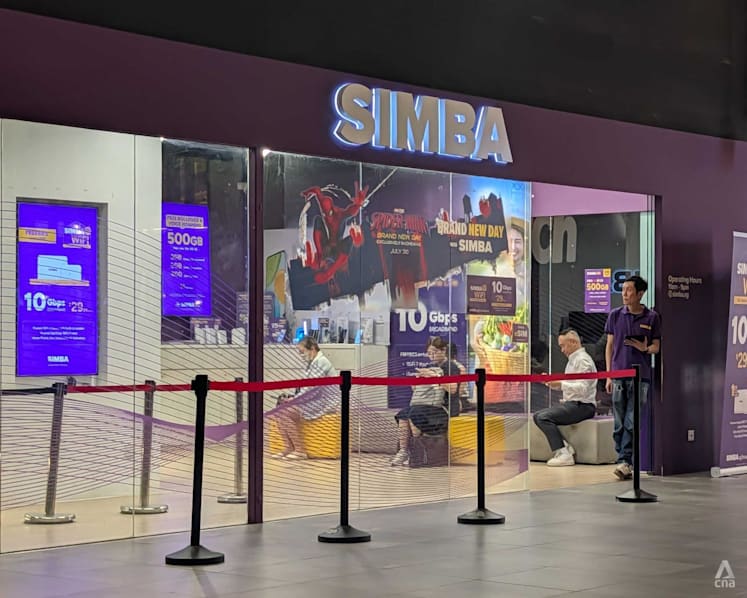
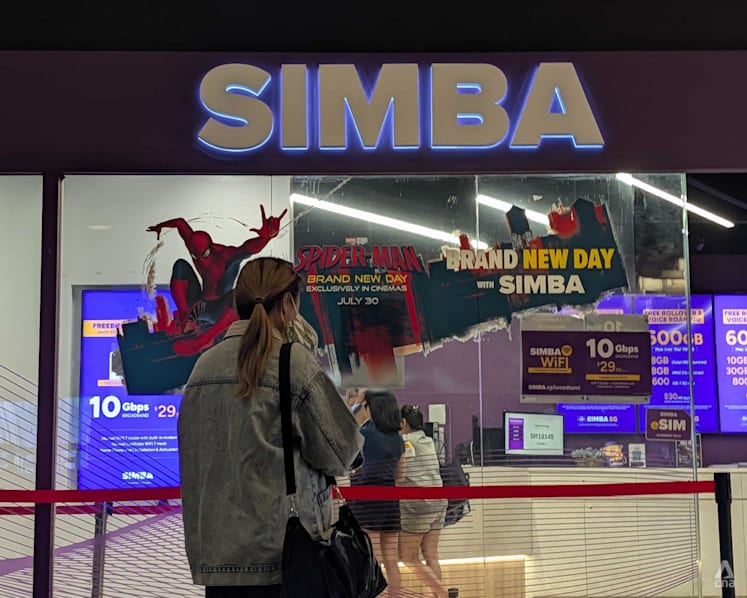 A Simba outlet at Orchard Gateway on Nov 10, 2026. (File photo: CNA/Wallace Woon)
Taking into account Simba’s sizable customer base, a hefty fine and requirements for a governance overhaul would be more probable than a cancelled licence.
Simba should be able to afford the financial penalties if meted out. Despite ongoing regulatory uncertainty, its parent Tuas reported a massive 277 per cent jump in full-year net profit, thanks to new subscriber acquisitions.
Still, a large penalty could weaken the telco’s finances and ability to beef up its 5G infrastructure. The latter has been Simba’s biggest challenge. As a latecomer, it has not had enough time or capability to build its networks and currently holds the smallest share of 5G spectrum - an issue it had hoped to overcome with M1, but failed.