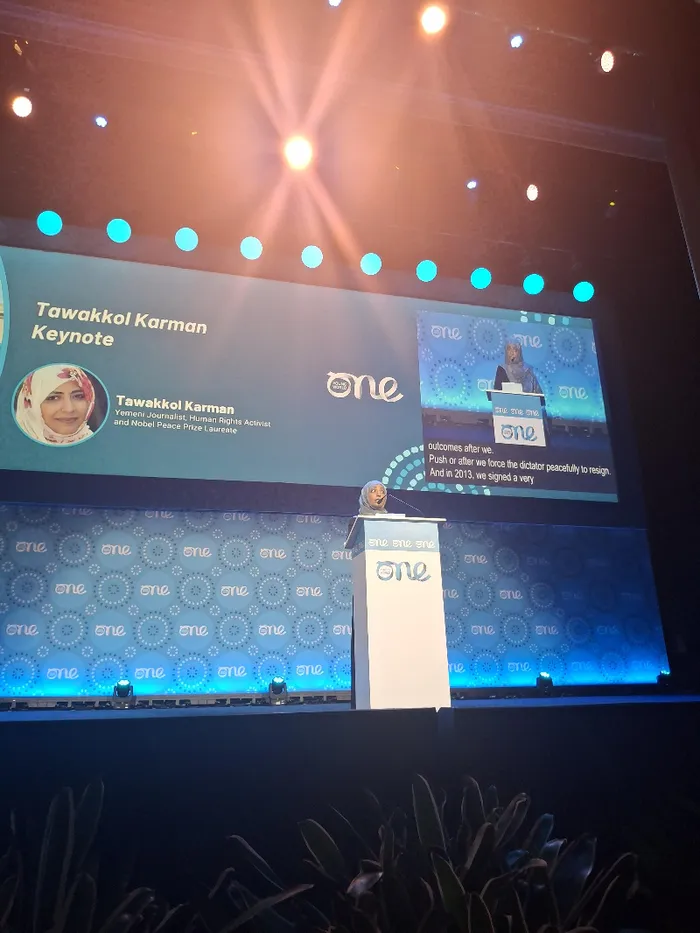
Tawakkol Karman giving a keynote address at the One Young World Summit 2026.
Day two of the 2026 One Young World Summit in Cape Town featured a panel on ethical philanthropy, followed by a keynote address by Yemeni journalist and Nobel Peace Prize laureate Tawakkol Karman.
Reimagining ethical philanthropy
The session—What Does Ethical Philanthropy Look Like in 2026?—was held on the Sandoz Access Stage.
The panel featured Rosie Allen-Herring, president and chief executive officer of United Way of the National Capital Area; Eli Manderson Evans, co-chief executive officer of the UK-based Blagrave Foundation; and Maheen Kaleem, vice-president of operations and strategy at Grantmakers for Girls of Colour.
Allen-Herring argued that philanthropy must remain rooted in local communities.
“I still have to depend on what takes place in the local community,” she said, pointing out that while issues like poverty and disenfranchisement are common, the answers must come from within the community.
“The solution is generally right there. It’s simply how we come together in a united way to ensure that we are bringing those solutions to bear,” she said.
Allen-Herring urged funders to alter the way they assess success. Instead of tallying the number of people reached, she suggested that foundations should concentrate on whether there has been an actual improvement in people’s lives.
She also urged donors to invest in organisational capacity and give change makers room to experiment.
“We have to become comfortable funding people with the ability and the capacity to feed themselves while they’re figuring it all out,” she said.
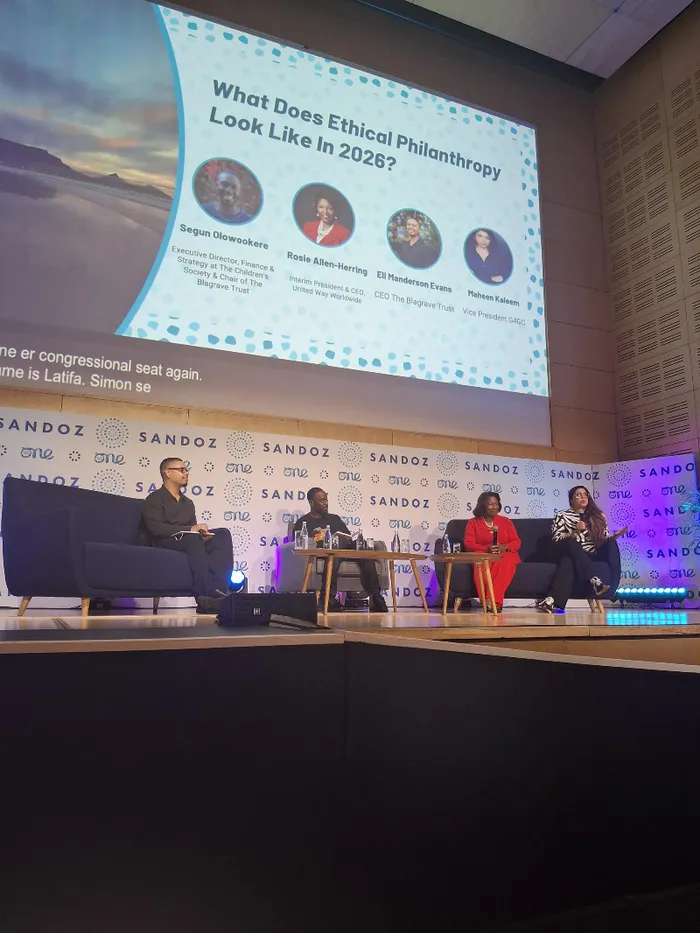
Speakers discuss community-led giving and ethical philanthropy on the Sandoz Access Stage during Day 2 of the 2026 One Young World Summit in Cape Town.
Sharing power with young people
Manderson Evans said funders needed to acknowledge that they did not have all the answers.
Under Blagrave’s “Leading with Hope” strategy, the foundation shifted from national funding in England to place-based initiatives in Birmingham, East London and Portsmouth.
He said the foundation focused on creating conditions in which young people could succeed.
“We don’t really talk about scaling work. We talk about enabling the sustainability of work,” he said.
Creating safe spaces for young people to fail and learn from those failures was central to that approach, he added.
Manderson Evans also criticised the slow pace of institutional funding and called for more young people to serve on foundation boards.
“With urgency, I hope that in 10 years’ time, there is a deeper commitment to moving quickly. I think sometimes philanthropy can move like dinosaurs,” he said.
Half of Blagrave’s board is made up of young people, he said, adding: “That should not be unique in this sector. I want to see more young people on boards.”
Rethinking capital and returns
Kaleem focused on the redistribution of resources and the importance of returning capital to the communities from which it had been extracted.
According to Kaleem, “It is important that we keep encouraging members of our communities to join philanthropic bodies and take charge of the resources taken from our communities.”
She called on donors to support social ventures, businesses and individuals, rather than restricting funding to tax-exempt non-profit organisations.
She said that assumption reflected “a very traditional kind of capitalist way of thinking about return” and argued that impact investing and philanthropy could coexist while assessing social returns in different ways.
Allen-Herring closed the session by arguing that philanthropy should not be seen as the preserve of wealthy institutions.
“Everyone is a philanthropist, everyone can do something, even if we think that it’s small, but if enough people do it, then it’s enough to scale that change,” she said.
Tawakkol Karman calls for courage
At the Presentation stage, the focus then shifted from philanthropic reform to democratic activism, with a keynote address by Tawakkol Karman. Known as the “Mother of the Revolution."
Welcomed by fellow activist Kate Anderson, Karman began with an Arabic saying of “Inshallah,” meaning “God willing.”
She described One Young World as one of her most important annual gatherings and said it gave her a sense of belonging to a global community committed to social justice.
Turning to Yemen, Karman described it as a country struggling for freedom, dignity, democracy, and accountability.
She said the country’s democratic transition had been damaged by the Houthi takeover, which she described as being backed by Iran.
Karman called on the international community to support the Yemeni people’s pursuit of peace, the rule of law, and accountability.
She also expressed solidarity with people in Iran, Palestine, Sudan, and Ukraine.
“Freedom also for Iran, freedom for Palestine, and freedom for Sudan. Freedom for Ukraine,” she said.
Referring to recent United States election results, Karman said civic participation remained decisive. She urged delegates not to underestimate their collective influence, power and to not give in.
Karman said voters were motivated by their values rather than narrow party loyalty.
“They voted for the values. They voted against hate. They voted against racism. They voted against the collapsing of institutions,” she said.
She also challenged the idea that democracy was exclusively a Western tradition, pointing to Yemen’s long history and invoking the legacy of the Queen of Sheba.
Karman praised South Africa for producing global moral leaders, including Nelson Mandela and Archbishop Desmond Tutu.
But she cautioned that protest alone was not enough. Sustainable freedom, she said, required strong legal and political institutions.
“Freedom needs courage,” Karman said. “When we achieve freedom by revolution, we have something else after that. We have justice and strong institutions.”
A call for generational leadership
In her closing remarks, Karman challenged young leaders to take responsibility for democratic renewal.
“Now it’s me and you who fight corruption, who fight climate change, who fight autocracy, who fight discrimination, I’m not talking about what is bad that is happening to us. I’m talking about the light,” she said.
“Believe in yourself and believe in your ability to change. Believe in your ability to lead.”