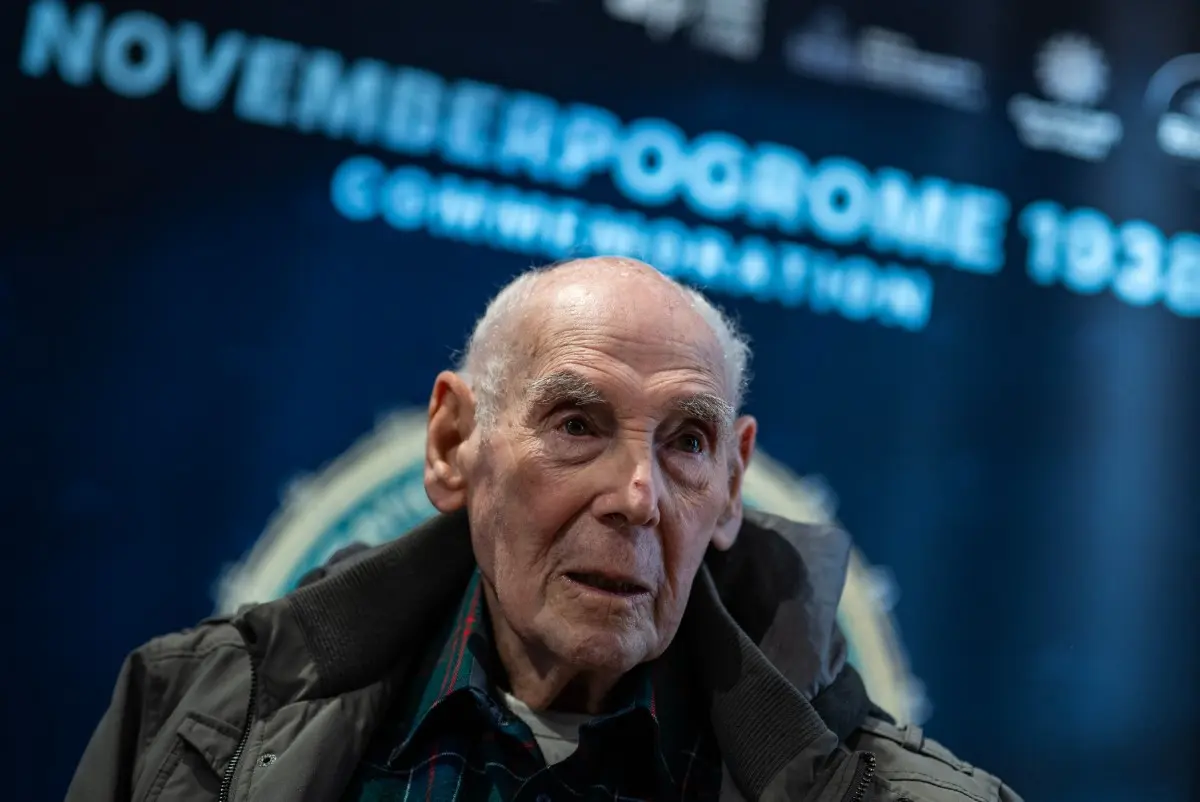
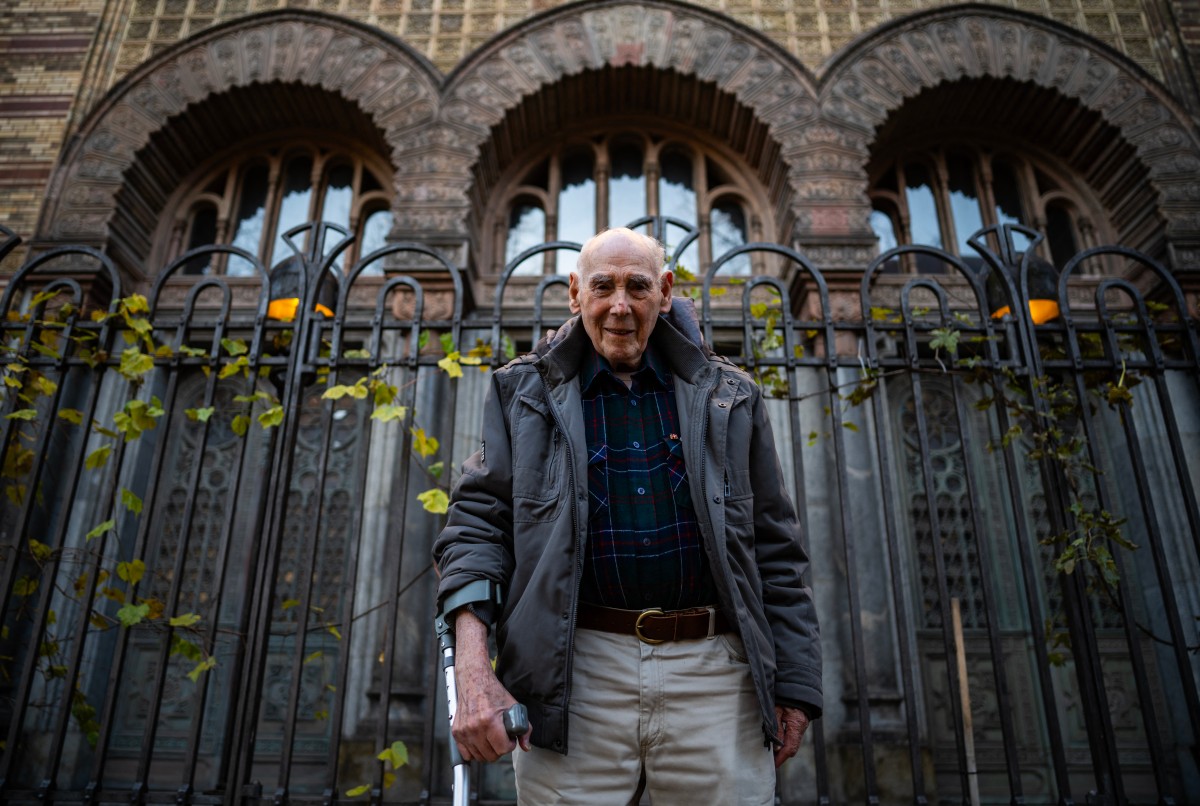
 Night of Broken Glass (Kristallnacht) survivor George Shafi, who will be 95 on November 29, 2026, prepares for an interview in front of the Neue Synagoge in Berlin on November 5, 2026, ahead of commemorations of the November 1938 Pogroms. (Photo by John MACDOUGALL / AFP)
For George Shefi, a 94-year-old survivor of Nazi Germany's "Kristallnacht", bearing witness to the pogroms targeting Jews is his final "mission" -- all the more urgent in the face of a renewed wave of anti-Semitism.
"Our generation is the last generation that can tell the true story," Shefi told AFP ahead of Monday's 88th anniversary of the events also remembered as the "Night of Broken Glass".
The wave of violence unleashed by the Nazi regime on November 9-10, 1938 saw at least 90 Jewish people killed and 1,400 synagogues set alight across Germany.
Shefi, born Spiegelglas in 1931, was just six years old when the anti-Semitic riots shook his home city of Berlin.
Don't miss our journalists' daily news roundup from Germany
His mother did not let him out of the house in the capital's Schoeneberg district for three days, but when he finally emerged, he was confronted with a radically changed city.
"My school was burned down," he told AFP, speaking last Thursday at a ceremony at the New Synagogue in Berlin organised by the International March for the Living, a Holocaust remembrance group.
"I remember very clearly a hat shop which was broken into, glass all over the place, women's hats all over the place. That made a big impression on me."
Another of his memories is of a stationery shop owner being "jeered" by dozens of onlookers while clearing up anti-Semitic graffiti.
"They wrote in big letters: This store belongs to a Jewish pig who is married to a Christian sow."
Months later, just before the outbreak of World War II, George was placed on a train that would take him to safety in the United Kingdom, in a rescue effort known as the Kindertransport that saved almost 10,000 children.
His mother dropped him off at a train station before getting in a taxi to a different stop, where more children were due to be picked up.
"Unfortunately, I saw her running on the platform but she never saw me. And that's the last time I saw her."
George was taken to stay with distant relatives in London, before being evacuated to the rural English county of Lincolnshire.
He received one letter from his mother during the war, via the Red Cross, and never heard from her again.
He later found out that she was deported to Auschwitz, arriving at the death camp on January 30, 1943.
"As far as I could calculate, she was murdered the same day."
Some six million Jews were killed in the Holocaust.
After a brief stay in the United States, Shefi settled in Israel following the war.
In the past 25 years, he has travelled back to Germany to tell his story, sharing his experience with more than 12,000 schoolchildren.
His message for German pupils: "I want to convince you that you're not allowed to forget the Holocaust."
Shefi has told them that "you're not responsible for what was, but you're responsible for the next 20, 30 years when you grow up and you're going to lead this country".
But the world has changed in the decades since Shefi first began retelling his story.
Anti-Semitic offences in Germany have surged from around 1,400 in 2015 to 6,500 last year according to police figures.
The situation has worsened since the October 7, 2023 attacks led by Hamas against Israel and the subsequent war in Gaza.
Meanwhile, Germany's culture of Holocaust remembrance is under threat, with the far-right Alternative for Germany (AfD) often railing against what it calls a "cult of guilt".
In September, an AfD-backed motion passed in the eastern town of Heidenau banning the creation of new "Stolpersteine," small public inscriptions commemorating the victims of Nazi persecution.
George was well aware of the development.
"I think it has to be fought tooth and nail," he said at the Berlin ceremony.
"People have to wake up to it, and if you want to keep this country democratic, you have to start immediately to fight against such situations."
Soon to turn 95, George is still engaged in what he calls his "mission" to combat anti-Semitism.
"We are the ones that have to tell, as long as we can, the truth."
Become a member or log in to continue reading
More
Comments
Join the conversation in our comments section below. Share your own views and experience and if you have a question or suggestion for our journalists then email us at news@thelocal.de.