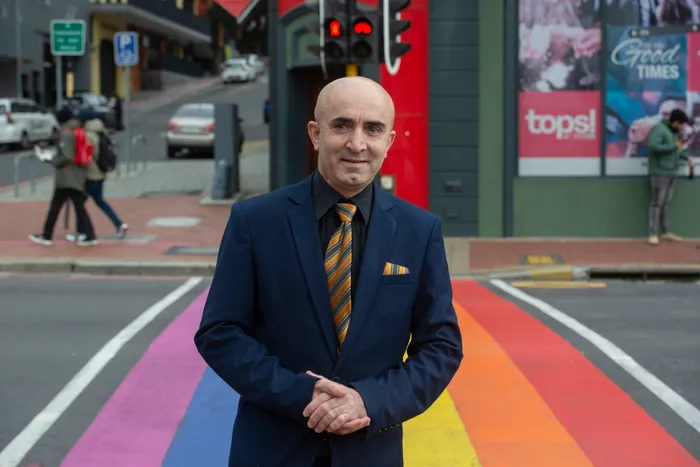
Mehmet Vefa Dag, President of the Truth and Solidarity Movement.
Image: Armand Hough/African News Agency(ANA)
The Cape South African Jewish Board of Deputies (SAJBD) is asking the Equality Court to declare a series of social media statements by Truth and Solidarity Movement president Mehmet Vefa Dag hate speech, including alleged posts claiming that Jewish people have “ruined South Africa”.
The statements, which the organisation says were published on X during 2023 and 2024, include: “Jews have ruined SA”; “Jews are looting SA”; “Jews are dogs, they should be burned”; and “One hundred thousand Jews control the entire economy of South Africa.”
The SAJBD argues that the statements are harmful, incite harm and promote or propagate hatred against Jewish people. Its legal application was launched in October 2024.
Cape SAJBD executive director Daniel Bloch said the application outlined what the organisation described as a pattern of antisemitic rhetoric.
“In our application, we outline how Dag's statements portray Jewish people as evil, morally corrupt and wicked, accuse Jews of secretly controlling the South African and global economies, and perpetuate dangerous antisemitic conspiracy theories about Jewish money, power and influence,” he said.
“His statements go further, advocating for the forced removal of Jews from South Africa, encouraging boycotts and reprisals against Jewish people and their businesses, and promoting Holocaust denial, including claims that the Holocaust never occurred and was fabricated by Jews to advance their own interests,” he added.
The SAJBD is seeking an order compelling Dag to issue an unconditional apology to the South African Jewish community, donate R50 000 to the Cape Town Holocaust & Genocide Centre and pay the legal costs of the proceedings.
Dag rejects demand for apology
Dag has rejected any suggestion that he should retract his statements, arguing that they constituted legitimate criticism of the Israeli government.
He said that if particular wording had been interpreted as targeting Jewish people collectively, that distinction needed to be addressed. However, he would not apologise simply because “powerful organisations” were uncomfortable with such criticism.
“I reject antisemitism, racism and hatred against people because of their religion or identity. But I will never accept that criticism of the Israeli government, its military actions or policies towards Palestinians must automatically be treated as hatred of Jewish people. These are fundamentally different issues,” Dag said.
“No community should be collectively blamed for the actions of a government. However, I will not apologise for standing with innocent Palestinian civilians, demanding accountability or speaking against injustice. We are prepared to engage on the basis of facts, evidence and equal human dignity. But legal pressure will not make us abandon legitimate human-rights advocacy.
“We will not be intimidated into silence. We will continue to speak, organise and demand accountability through lawful and democratic means,” he said.
Jewish Board says eight other matters are active
The Cape SAJBD said it currently has eight additional active matters involving allegations of hate speech, antisemitism and defamation. These are being pursued through the Equality Court, High Court and South African Human Rights Commission.
Bloch said the organisation had seen some individuals reduce or stop their alleged conduct after receiving legal papers.
“We have already witnessed the impact of these legal interventions. In several instances, individuals who previously engaged in repeated hateful rhetoric have significantly reduced or ceased such conduct after being served with legal papers. This demonstrates the importance of holding people accountable and ensuring that hatred does not go unchallenged,” he said.
Church leader calls for reconciliation
Western Cape Provincial Council of Churches outgoing chairperson Reverend Rodney Whiteman called for respect for all religious and ethnic communities, saying criticism should focus on injustice and oppression rather than people's identities.
“I pray that the parties involved meet at the table of reconciliation, speak their hearts out, and my oppressive history be confessed, and forms of reparations be agreed upon. It is not the person or creed or culture we must speak to; it is the behaviour of greed, oppression, disenfranchisement, of the past and present that must be addressed,” Whiteman said.
The matter is expected to return to court on 17 February 2027.