Performers from 11 countries including Laos, the Philippines and South Korea are battling it out for the first Asia crown, in a contest featuring Bangladeshi beatboxing, Vietnamese pop and a love song by a Mongolian economist.
Thailand's contestants Mang x Daou perform during the preview show of the Eurovision Song Contest Asia 2026 at One Bangkok Forum in Bangkok on Nov 13, 2026. (Photo: AFP/
Chanakarn Laosarakham)
Thailand's contestants Mang x Daou perform during the preview show of the Eurovision Song Contest Asia 2026 at One Bangkok Forum in Bangkok on Nov 13, 2026. (Photo: AFP/
Chanakarn Laosarakham)
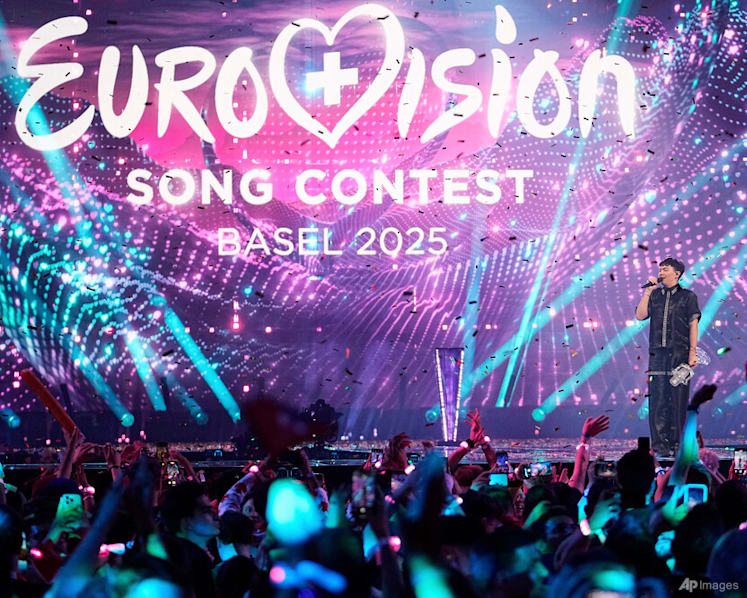
BANGKOK: Eurovision fans sporting flags and bright outfits gathered on Saturday (Nov 14) in Bangkok for its first Asia edition, featuring Bangladeshi beatboxing, Vietnamese pop and a love song by a Mongolian economist.
Performers from 11 countries also including Laos, the Philippines and South Korea are battling it out for the first Asia crown of a contest famed in Europe for its lavish outfits, soaring vocals and sometimes tricky geopolitics.
"I'm very pleased it's come to Asia. We've been waiting so long!" said Malaysian mega-fan Fauzan, 37, one of the first in the queue to enter the concert hall in the Thai capital.
He was wearing a blue corset over a white trouser suit in honour of his nation's entry Aina Abdul, who is wearing similar colours to perform her song "Bluest Sky".
CNA Games
 Guess Word
Crack the word, one row at a time
 Buzzword
Create words using the given letters
 Mini Sudoku
Tiny puzzle, mighty brain teaser
 Mini Crossword
Small grid, big challenge
 Word Search
Spot as many words as you can
Show More
Show Less
Eurovision is the world's biggest televised live music event, drawing 131 million viewers in 2026, and over the past 70 years has helped to launch the careers of artists such as ABBA and Celine Dion.
It is a cultural phenomenon in Europe, but the big question is whether it takes off in Asia, the world's most populous region with more than enough music shows of its own.
Fauzan, who declined to give his family name for privacy reasons, cited Eurovision's advocacy of LGBTQ rights as one reason he loves it, saying the 2014 victory of Austrian bearded drag queen Conchita Wurst was a turning point.
"It was something new in the acceptance of LGBTQ. It was an eye-opener," he said.
The contestants are largely stars in their own countries, from Malaysia's Aina to Vietnamese pop star Toc Tien, but some have a less typical background.
Mongolian singer Beck has a day job as an economist who advises the deputy prime minister.
"It's very important for me to show up, to show respect to our ancestors on this big stage," he told AFP this week, wearing an orange-and-gold traditional outfit he described as a "suit of a warrior".
Carmelle, from the Philippines, will sing about female empowerment, Bryan Adams fan Pratik Himal Rai will perform a rock song with masked dancers for Nepal, and South Korea and Thailand have sent pop stars.
"MORE INNOCENT THAN EUROPEAN VERSION"
Votes are gathered by participating country - half from a jury and half from viewers - and no nation can vote for itself, meaning ballots are often cast based on national relationships.
In Europe, this sometimes reflects diplomatic tensions, although there is little sign of that so far in Asia, with executive producer Assaf Blecher saying the edition was "a little bit more innocent".
The expansion comes as Eurovision marks its 70th birthday under a cloud, with 2026 viewing figures down 35 million on-year after a boycott by five countries over Israel's participation.
Organisers brush off any link between this controversy and the Asia show, noting the contest has been trying to expand for years. There was a US version in 2022, but it fell flat.
India, Japan and China are notable by their absence in Saturday's contest, while Bangkok seemed underwhelmed, with tickets still available just hours before showtime.
But Martin Green, director of the European Broadcasting Union, which organises Eurovision, said it could take "two, three, five years" to establish the brand.
"Eurovision number one was basically with seven singers doing two songs each with a pot plant and a microphone," he told reporters, saying Saturday's show was "profoundly not the case".
The show will be broadcast on commercial television in the participating countries and on YouTube, beginning at 1.30pm GMT with results due around 4pm GMT.
Morning Brief
An automated curation of our top stories to start your day.