The provincial government has been building sports facilities, including urban boxing arenas, to curb street fights. But experts say deeper issues behind youth violence should also be addressed.
Jakarta's provincial government has been developing sports facilities and public spaces to help young people channel their energy into positive activities. (Photo: CNA/Denny Armandhanu)
Jakarta's provincial government has been developing sports facilities and public spaces to help young people channel their energy into positive activities. (Photo: CNA/Denny Armandhanu)



JAKARTA: Under a busy flyover in East Jakarta, two boxers trade punches under the watchful eye of a referee.
Their jabs, hooks and uppercuts appear haphazard, landing a blow to their opponent's face or body with little sign of defensive technique or fancy footwork.
Still, the crowd - made up of spectators of all ages - seem entertained, laughing and teasing their friends as they fight.
After about a minute of intense sparring, the two novice boxers are already visibly out of breath. They step out of the ring to make way for the next pair of eager fighters waiting their turn, cheered on by the crowd.
CNA Games
 Guess Word
Crack the word, one row at a time
 Buzzword
Create words using the given letters
 Mini Sudoku
Tiny puzzle, mighty brain teaser
 Mini Crossword
Small grid, big challenge
 Word Search
Spot as many words as you can
Show More
Show Less
On this Sunday mid-November afternoon, the atmosphere is warm and friendly. But some of those laughing together had once fought each other in street brawls that could turn deadly.
"That guy in the red shirt used to be my enemy," said one of the boxers, Farhan, 20, who goes by one name, pointing to someone nearby in the audience.
"But after meeting here, we've become close friends."
 The Kampung Melayu boxing arena has attracted people of all ages, from young children learning the basics to adults taking part in sparring sessions. (Photo: CNA/Denny Armandhanu)
 The arena in Kampung Melayu has drawn young children eager to learn boxing, offering them an alternative to spending their time on the streets. (Photo: CNA/Denny Armandhanu)
 The boxing arena allows young people to settle their differences through supervised matches rather than street brawls. (Photo: CNA/Denny Armandhanu)
To curb youth brawls, Jakarta's provincial government has been building sports facilities, including the boxing ring beneath the Kampung Melayu flyover which launched this month, following the reported success of a similar facility in Pasar Rebo district in East Jakarta City, which was inaugurated in May 2026.
The move is aimed at tackling the long-standing issue of brawls between rival communities, which has spread through densely populated neighbourhoods in Jakarta, such as Kampung Melayu.
"I've been injured before. My hand was slashed open. My eye, shoulder and stomach too," said Galih Hatsuka, 31, a heavily tattooed spectator at the ring.
"Our enemies lived just across the street. Even leaving our own neighbourhood could get us slashed, stabbed or grabbed."
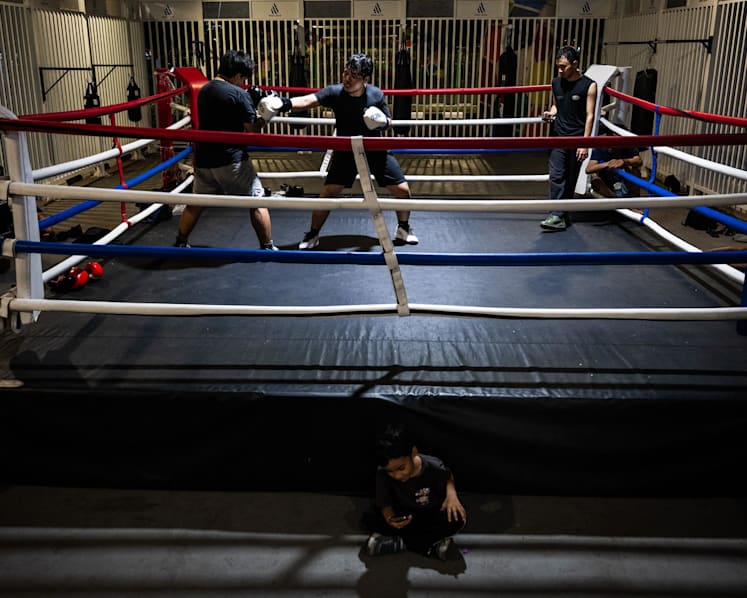 The boxing ring beneath the Kampung Melayu flyover in East Jakarta aims to help curb street brawls. (Photo: CNA/Wisnu Agung Prasetyo)
A conflict resolution expert welcomed the boxing arena as a way to curb street brawls, but stressed that sports facilities alone would not address the root causes of youth violence.
"Street brawls are a complex problem. The solution must be comprehensive and integrated, not just about building sports facilities," said Ichsan Malik, a peace and conflict resolution lecturer at Indonesia Defense University.
CURBING STREET BRAWLS THROUGH SPORTS
Street brawls remain a persistent problem in Jakarta and its surrounding areas. Police recorded 440 incidents of brawls across the Greater Jakarta police jurisdiction in 2025.
The violence has continued into 2026. At least two people were killed in separate brawls in West Jakarta in January and October.
At the opening of the Kampung Melayu boxing arena on Nov 6, Jakarta Governor Pramono Anung said sports facilities had helped cut street brawls in East Jakarta from around 130 in 2025 to just over 20 by the end of October 2026.
"That means more than 100 fewer brawls ... I asked the young people here, and they told me they're now channelling their energy into boxing and playing football together," Pramono said.
 Young children learn basic boxing techniques under the guidance of local coaches at the Kampung Melayu arena, part of Jakarta's efforts to steer young people away from street brawls. (Photo: CNA/Wisnu Agung Prasetyo)
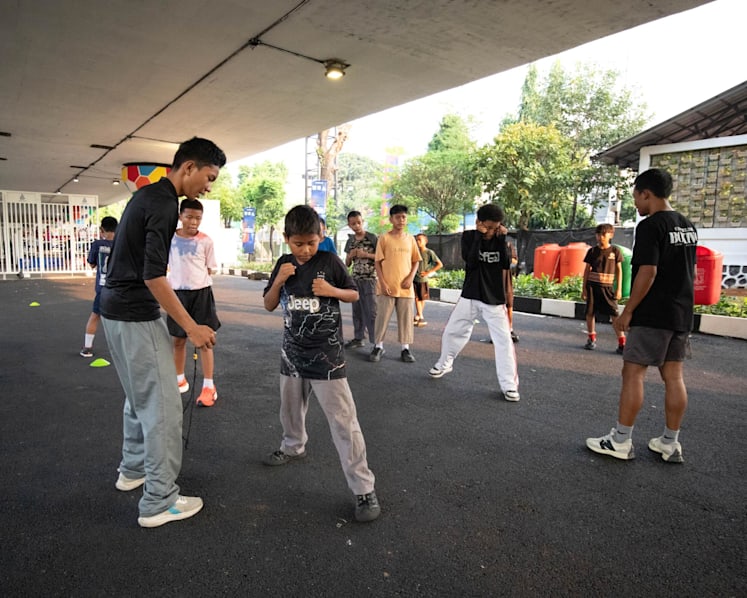 People of all ages, including young children, take part in boxing training at the Kampung Melayu arena in East Jakarta. (Photo: CNA/Denny Armandhanu)
 Beginners at the Kampung Melayu arena learn basic boxing techniques before progressing to sparring under the guidance of local coaches. (Photo: CNA/Wisnu Agung Prasetyo)
 Friendships formed at the Kampung Melayu boxing arena have extended beyond the ring, with trainees meeting up and exercising together. (Photo: CNA/Wisnu Agung Prasetyo)
Beyond boxing rings, Jakarta's provincial government has also been building sports facilities and public spaces across the city, including skate parks and sports courts, to help young people expend their energy and develop their interests.
Before the boxing arena was built, the space beneath the Kampung Melayu flyover was a park and an open paved area.
"Back then … we could get slashed. But incidents like that have become less common," Galih said.
"Places like this (boxing arena) are really useful. I'd say they've helped reduce brawls by 99 per cent."
 Galih Hatsuka, 31, stopped getting into street brawls at 27 after taking up boxing at a military gym, where he learned discipline and began changing his life. (Photo: CNA/Wisnu Agung Prasetyo)
Galih, who works as a chicken meat supplier, admitted that his younger years in Kampung Melayu were marked by street brawls.
The scars on his body bear witness to his violent past, including a stab wound to his hand that left him bleeding heavily. But boxing has gradually changed the course of his life, he said.
"I stopped getting into brawls when I was 27, after I started training at a military boxing gym. That's where I learned discipline and built my character," Galih added.
A week after the Kampung Melayu arena opened, CNA found it bustling with locals. Outside the entrance, children lined up to learn basic boxing techniques, while teenagers practised punches and blocks in pairs inside.
"The enthusiasm here is crazy. What makes me happy isn't the older kids coming, but seeing the little ones joining in too," said Rafli Alfiansyah, 19, who also trains at the gym.
"I've also seen many of those who used to get into brawls coming here. They want to try boxing."
 Rafli Alfiansyah, 19, says he has seen young people who once took part in street brawls turning to boxing at the Kampung Melayu arena. (Photo: CNA/Wisnu Agung Prasetyo)
The boxing arena is open daily, with two sessions running from morning to midday and from late afternoon into the evening. Locals with boxing experience volunteer as coaches, including Muhammad Ilham Sodri, a 21-year-old university student.
"I want to steer the kids here away from negative activities and towards something positive in the boxing ring," Ilham told CNA.
According to Ilham, beginners go through three stages of training: cognitive, associative and autonomous.
"At first, we teach them slowly, usually for a week or two. Then they move on to the associative stage, where they can start practising on their own," he said.
"The final stage is autonomous. By then, they've mastered the basics and can start sparring."
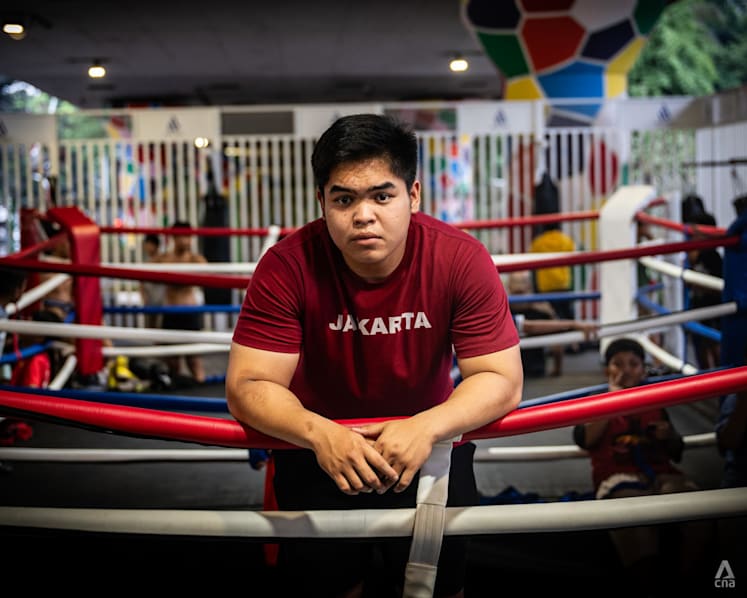 Muhammad Ilham Sodri, 21, volunteers as a boxing coach to help steer young people away from street brawls and other negative activities. (Photo: CNA/Wisnu Agung Prasetyo)
But many trainees cannot wait that long to start sparring. Their punches fly in all directions and their guards are wide open, but they're clearly enjoying every second.
"Boxing is fun. Maybe it's the testosterone rush. It works your legs, your body and your mind," said Rafli.
"Boxing is also a mental game, like chess. You need strategy."
 The novice boxers throw punches with little technique, their defence and footwork still rough. Yet they are clearly enthusiastic and enjoying every moment in the ring. (Photo: CNA/Denny Armandhanu)
TRADING BLOWS, NOT HOLDING GRUDGES
Rafli said that before the boxing arena opened, organisers from a local community group had reached out to leaders of groups frequently involved in street brawls in and around Kampung Melayu.
They brought the rival groups together for discussions and encouraged them to settle their disputes through boxing matches rather than fighting on the streets.
"The leaders then encouraged those who often got into brawls to do the same. 'If you're so tough, why not fight here instead?'" Rafli said.
 Galih Hatsuka, 31 (left), and Rafli Alfiansyah, 19, spar at the Kampung Melayu boxing arena, where young people are encouraged to settle their differences through sport rather than street brawls. (Photo: CNA/Wisnu Agung Prasetyo)
Once bitter rivals in street brawls, they now face each other in the boxing ring, trading punches under the rules of the sport rather than settling scores through violence.
"Some of the people I used to get into brawls with are now training here too," Farhan said.
"We can trade punches in the ring. But once we step out, it's over. No grudges outside the ring."
Rifat Abigail, 17, said he had come face to face at the boxing arena with someone he once fought with.
"We used to slash at each other. But now, when we meet here, we're cool. Things aren't like they used to be," Rifat said.
 A boxer takes a punch to the face during a sparring session at the Kampung Melayu arena in East Jakarta, where former rivals now trade blows in the ring but remain friends outside it. (Photo: CNA/Wisnu Agung Prasetyo)
 Trainees fight in a supervised setting, sometimes forming new friendships where there were once bitter rivalries (Photo: CNA/Denny Armandhanu)
 A boxer takes a punch during a sparring session at the Kampung Melayu arena in East Jakarta, where beginners learn to trade blows under the supervision of coaches and referees. (Photo: CNA/Wisnu Agung Prasetyo)
Galih has had a similar experience, now training and sparring alongside people he once considered enemies in street brawls.
Their friendships have even extended beyond the ring.
"We never talk about the past. We talk about our plans for the future. Now we hang out over coffee and chat about when to train together again or where to go jogging," Galih said.
The boxing arena also gives young people a place to settle disputes in the ring rather than through street brawls.
According to Ilham, anyone can use the ring for a match, with clear rules and supervision from experienced referees and coaches who volunteer from the local community.
"There was a brawl recently, and they settled it here. They exchanged punches. But once they left the ring, they made peace, became friends and shook hands," Ilham said.
 Muhammad Ilham Sodri, 21 (left), teaches boxing techniques to a trainee at the Kampung Melayu arena. The university student volunteers as a coach to help young people develop their skills and stay away from street brawls. (Photo: CNA/Denny Armandhanu)
Several gangster accounts have even contacted the arena's organisers on Instagram, asking if they could use the ring for matches.
"A lot of gangster accounts have been tagging us, asking, 'Hey admin, can we use this boxing arena for a match?'" said Rafli, who manages the arena's official social media account.
Encouraged by the friendships formed at the arena, Jakarta Governor Pramono Anung is considering similar facilities elsewhere, including Manggarai in South Jakarta, another area prone to street brawls.