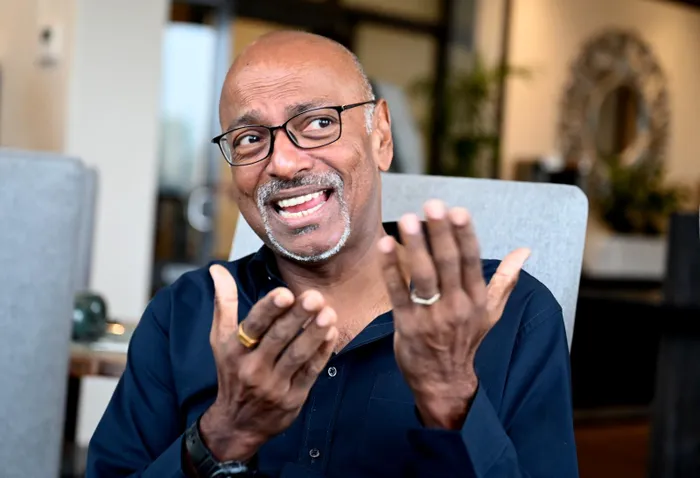
Malaysian celebrity Chef Shankar R. Santhiram.
Malaysian Tamil chef and digital creator Shankar R. Santhiram has cultivated a devoted online following.
The restaurateur behind Fire by Shankar is widely recognised for his soothing voice, infectious smile and nurturing demeanour, all beautifully showcased throughout his culinary videos.
His team can frequently be heard in the background of his social media posts calling out their favourite dishes, which he happily cooks for them.
A passion for Mzansi’s food scene
Whenever he lands on local soil, his genuine love for Mzansi and its vibrant Indian culinary landscape remains unmissable.
When he isn’t exchanging notes with fellow culinary figures, he can be found sampling iconic local haunts, from tucking into the famed fare at Gounden’s Restaurant & Takeaway in Durban and Dosa Hut in Fordsburg, Johannesburg, to experiencing Vadivelu on Kloof in Cape Town.
During a recent visit, he highlighted his strong tie to South Africa while shooting episodes for his television debut, "Shankar's Saapadu Story South Africa".
I was fortunate to carve out 45 minutes to speak with him, even though it briefly interrupted his treasured time with his wife, Dr Susanna Santhiram-Hofherr (warmly known as Susie).
Opening our interview with a delightful surprise, he remarked: “Well done with ‘The National’ ... I know it’s only been a couple of weeks since your official start.”
This thoughtful gesture reflects his characteristic warmth, demonstrating how he consistently pays attention to the subtle nuances that foster meaningful relationships.
He confessed to deliberately skipping the pre-set questions, opting instead to keep our exchange fully unscripted.
This spontaneous approach was something I truly valued as well.
He laughed, “I'm sitting here, I've got a beautiful view of the Atlantic Ocean, I'm going to tell you whatever comes to my mind.”
Self-taught roots and early defiance
Santhiram unpacked his roots and how food became so strongly embedded in his career trajectory.
“Everything I do is based on those foundational flavours, because I'm not a textbook chef; I'm a self-taught chef. That part of me has come from years of hanging around the counter with my grandmothers, my aunties, and also my mom; that's where my love for food and cooking came from.
“Now, I'm 55 years old, which means I was born in 1971, and I grew up in an era when stereotypical behaviour was expected of an Indian boy growing up in a middle-class family. My father was a university professor, and my mother was a school teacher.
“My father felt certain obligations that I needed to adhere to as a boy, as the elder son. So, he would find me in the kitchen often with my mother and my grandmothers, and he would make snide comments like, ‘You know what are you doing in the kitchen? You're just going to grow up to be a fat cook’.”
Yet, he remained completely undeterred by the criticism. His curiosity and tenacity saw him pave the way for a career in the culinary world.
On how he finds the cooking style in SA, he admits, “The Durban lamb curry is your kind of national staple in South Africa for the Indian community; you keep talking about it, and everyone says it is the best curry in the world.
Decoding the power of the potato
“In this country, anyone of Indian heritage, South Indian especially, and also North Indians, get very visceral, emotional about the lamb curry. And I've eaten lots and lots of Durban mutton curries and lamb curries; the primary ingredient there is not the lamb, right? You need to have potatoes. If there's no potatoes, there's no lamb curry.”
I chuckled when he shared his observations as I grew up knowing that up-to-date potatoes are key to any good curry. And I’m from Durban, so I understand the unspoken rules around cooking.
He further explained the historical origins of using potatoes as a core staple. Looking back at previous generations, large households had to be fed on tight budgets, making this essential ingredient key to stretching meals further.
Santhiram added: “I think when people understand the historical context of South African Indian food, they will understand why the food tastes the way it does. Just like why so many South African Tamils don't speak Tamil. And it's not because people are ashamed of their language; there was a historical reason why that happened.
“That's why I'm drawn to the Indian community in South Africa, and I also think that's the reason why, especially the South Indian community primarily, are drawn to me; it’s because I understand this.
“I don't make judgments; I understand why the food tastes this way, the flavours are this way …”
Beyond the Big 5: Showcasing SA’s cultural soul
While filming his TV show here, he reflected: “I was talking to the Minister of Tourism in Mauritius on one of my shoots, and I said, ‘You know, people from my part of the world come to South Africa only for a couple of reasons: one is they come to go to a game park, game reserve … to see the Big 5.
"Another group of people tend to come to the casinos here, but nobody comes to South Africa just to holiday; there's a little bit of bad rap in terms of security, which I think is a real concern.
“But there are beautiful places in South Africa, beautiful cities that are safe, like every other city in the world. There are places that you shouldn't go to, but essentially, you should come there; and for the Hindu community, for example, there are some magnificent temples here.
“Places to go to in Johannesburg, historically charged temples in Johannesburg, in Durban, and even in Cape Town.
“I would like my viewers, people who come on to watch my videos, to watch my TV show, to see that food is great, we are very connected, we're very similar in so many ways.”
The broadcast date and platform availability for viewers remain unconfirmed at this stage.
That being said, he continues to maintain a stronghold on social media, connecting fans through his love for food and travel.
A magnet for international culinary talent
Naturally, Santhiram is hardly the sole culinary star drawn to South Africa for television productions. The nation’s rich tapestry of cultures and flavours makes it an irresistible hub for globally renowned chefs.
For instance, Gordon Ramsay journeyed to KwaZulu-Natal while shooting season two of National Geographic’s “Gordon Ramsay: Uncharted,” where he explored traditional Zulu cooking methods alongside author and “MasterChef: South Africa” judge Zola Nene.
Similarly, British chef Matt Tebbutt traversed the country for his 10-episode series, "A Taste of South Africa", diving deep into regional food heritage through open-fire techniques and wild ingredient foraging.
Also, Warren Mendes showcased our vibrant flavours to the world with his Food Network production, “Food Trail: South Africa”.