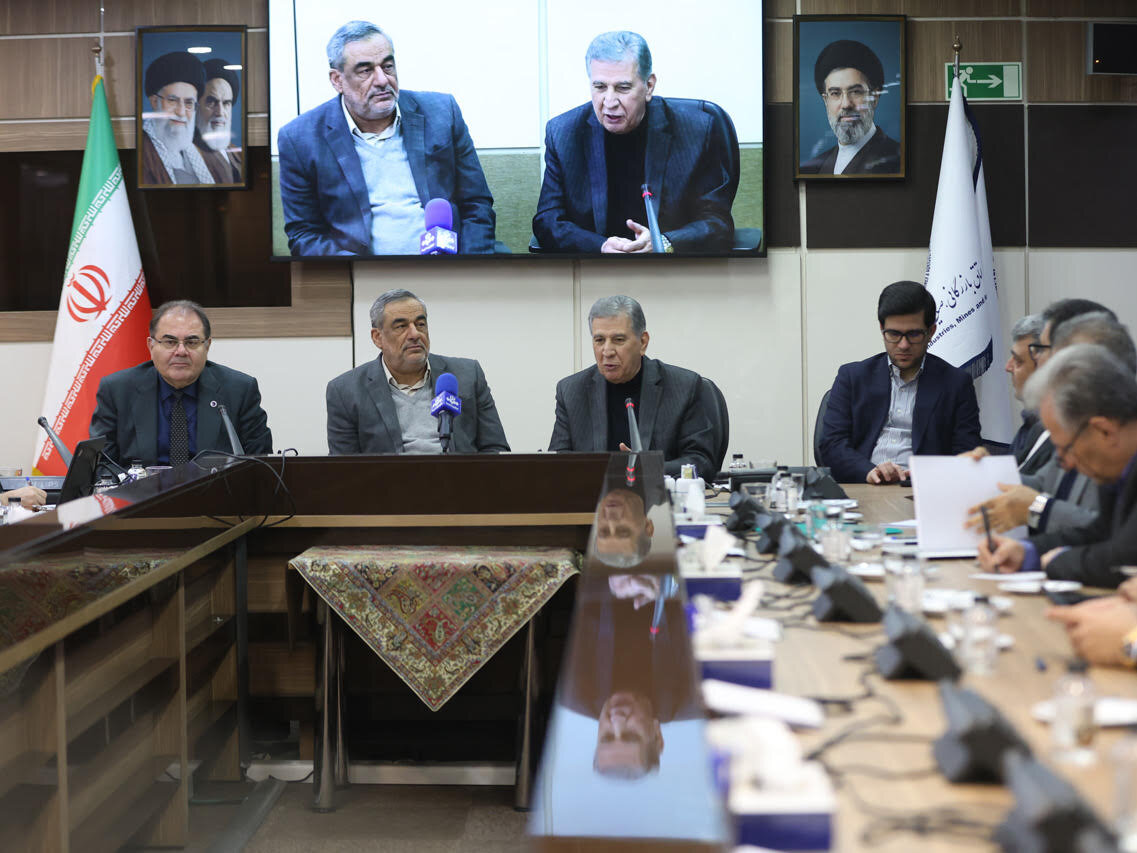
TEHRAN- At a meeting between the Acting Oil Minister and members of the Energy Committee and associations active in the oil and petrochemical industry, officials announced that 64 oil investment packages had been prepared for handover to the private sector.
The two sides also agreed to create a sustainable mechanism for interaction between the Oil Ministry and the private sector. The meeting brought together senior ministry officials, private-sector representatives, industry associations, and energy experts to discuss investment, production, contracting, technology, energy diplomacy, and removing obstacles to private participation.
Samad Hassanzadeh, President of the Iran Chamber of Commerce, Industries, Mines and Agriculture, said at the meeting that most private-sector companies are interested in investing across all areas related to the oil and petrochemical industry, especially in increasing production, improving productivity, and developing oil infrastructure, provided that suitable conditions are created for investors. He called for deliberate measures to remove restrictions on private-sector investment in oil projects. He also referred to past experience of cooperation between the private sector and the Oil Ministry in manufacturing and supplying specialized parts needed by the oil industry during Engineer Zanganeh’s tenure as minister.
Hassanzadeh stressed the necessity of completing the value chain in the oil and petrochemical industry. He added that defining clear investment packages and handing development projects over to the private sector is essential. He described the capacity of private companies to implement enhanced oil recovery projects as an opportunity for the growth of the country’s oil industry and emphasized the use of modern technologies to increase production. He also said the private sector has suitable capacity to participate in refinery optimization and modernization projects. He noted the institutional capacity of the Iran Chamber, including 34 provincial chambers, 41 joint chambers of commerce, 20 specialized commissions, more than 260 national economic associations, and the Research Center. He expressed hope that the country’s problems would be resolved while preserving the dignity of the Iranian nation and the authority of the Islamic Republic of Iran.
Hamid Bovard, Acting Oil Minister, emphasized at the joint meeting with private-sector activists the need to strengthen relations between the Oil Ministry and the private sector. He said the ministry seeks a permanent, regular, and structured relationship with economic actors. Referring to the private sector’s capacities in investment, domestic production, and energy diplomacy, he stated that the Iran Chamber can play an effective role in these areas. He added that the Oil Ministry is ready to use various investment models, from small projects to large plans.
Bovard said there is no technical limitation in the oil and gas production sector and referred to infrastructure reconstruction programs that are underway. He also pointed to the possibility of saving about 20 percent in gasoline consumption and said private-sector cooperation is essential in consumption management and reforming energy use patterns. He described energy diplomacy as another axis of the ministry’s work and, referring to negotiations with neighboring countries, reported follow-up of cooperation in the Caspian Sea area and use of the production-sharing model.
Hamid Hosseini, an oil and energy expert, highlighted investment opportunities in the upstream oil and gas sector. He said the sector has considerable economic capacity and that investment there can create added value and appropriate returns. However, many existing opportunities have not been properly introduced to investors. He identified the use of domestic financial resources, including micro-capital and resources available to the people, as one way to finance oil projects and stressed the need to design appropriate mechanisms to attract such resources. Hosseini also called for reforming investment contracts, arguing that aligning contractual conditions with investors’ needs can pave the way for greater private-sector participation in upstream projects. He described the development of oil trading on the Energy Exchange as a way to increase transparency and strengthen the presence of non-governmental companies in the oil market.
Erfan Afazeli, Secretary-General of the Oil Industry Federation and adviser to the Energy Committee of the Iran Chamber, referred to the private sector’s capacity to enter oil and gas field development projects. He called on the Oil Ministry to support the participation of economic actors in drafting the regulation for paragraph (b) of Article 15 of the Seventh Development Plan Law. He noted the recent action of the National Iranian Oil Company in handing over the contract for development and operation of the Zireh and Khartang gas fields. According to him, this move means the private sector has practically entered field development, especially gas fields, which is highly important given the country’s gas deficit. He assessed positively the cooperation of the National Iranian Oil Company and its Business Deputy in preparing the ground for private-sector presence.
Afazeli noted that paragraph (b) of Article 15 of the Seventh Development Plan addresses the production capacity of the non-governmental sector from the country’s oil and gas capacities. Accordingly, the private sector, through the Government-Private Sector Dialogue Council and the Business Support Committee, has requested that the executive regulation of this paragraph be drafted with an approach that supports the presence and participation of non-governmental actors. He said meetings had been held with representatives of the Oil Ministry, including the Planning Deputy, the National Iranian Gas Company, and the National Iranian Oil Company, but the process of drafting the regulation had stopped at some point. He stressed that, given private-sector interest, the ministry must support continuation of the work and participation of economic actors in drafting the regulation. He added that petrochemical companies and steel industries are also interested in investing in oil and gas field development, and that facilitating the issuance of licenses for exploration and production (E&P) companies by the Oil Ministry has created a suitable basis for expanding participation. He called for drafting the Article 15(b) regulation with direct private-sector cooperation and ministry support so that existing legal capacities become real investment opportunities and increased production.
Afazeli also addressed pressure-boosting contracts. He called for clarifying their status and accelerating implementation of contracts that have long remained unresolved. He said members of the Oil Industry Federation want acceleration in determining the status of pressure-boosting contracts, specifically the Phase 19 pressure-boosting project and the onshore section of the plan. He expressed hope that, with the ministry’s support, both the private-sector participation regulation for oil and gas field development would be drafted more quickly and the stalled pressure-boosting contracts would be resolved. According to him, such measures could revive contractor companies’ activity, employ engineers, and make use of domestic technical knowledge.
Nusratollah Seifi, head of the Optimization Committee of the Expediency Discernment Council, referred to the capacity of non-governmental companies in the energy industry. He said the private sector can play an effective role in restoring gas production capacities, developing energy trade, and expanding cooperation with neighboring countries. He considered private companies’ participation in energy exchanges with neighboring countries as one usable area and stressed the need to strengthen the country’s energy resilience. Seifi also said private-sector capacity should be used in projects to increase productivity and reduce energy waste, and emphasized the sector’s role in strengthening supply security and developing regional cooperation.
Ahmad Davoodi, representative of the Oil and Energy Club, referred to the legal capacities of the Seventh Development Plan and called for using the envisaged tools to attract domestic and foreign investors in oil industry projects. He said it is necessary to use the investment account capacity under Article 14 of the Seventh Plan and private-sector participation in implementing development plans. Davoodi also emphasized the use of production-sharing contracts under Article 44, especially for developing joint oil and gas fields, and described this model as one way to increase investor participation in oil industry projects.
Ehsan Saghafi, head of the Association of Oil Industry Equipment Manufacturers, stressed the need to preserve the production capacity of domestic manufacturers. He said equipment manufacturers must be able to have an effective presence in projects even under difficult economic conditions and restrictions in the oil industry. Referring to the technical and production capacity of Iranian companies, he said their capacity should be used in development projects, repairs, and infrastructure reconstruction. Saghafi also emphasized continuous and structured communication between the Oil Ministry and specialized associations. He proposed that a specific group in the ministry be responsible for following up on agreements and orders issued in joint meetings with the private sector. He stressed that merely holding meetings and raising problems is not enough; for each issue, a follow-up responsible person and a clear path to results must be determined.
Khatam, another energy sector activist, emphasized the capabilities of economic actors in helping achieve the country’s goals. He said the private sector has high capacity and ability to serve the people and can play an effective role in advancing the government’s plans and goals. He stated that the private sector has considerable ability and experience to influence various areas and emphasized that the government must use this capacity in the best way. By strengthening consensus and interaction with economic actors, the government should provide the ground for their more effective participation in implementing plans. He noted that the private sector has designed numerous plans and projects to optimize energy consumption levels that can be implemented with government support.
Farhad Gholich-Khani, an adviser and energy activist, referred to the capacity of private companies in international markets. He said the private sector can play a role in developing energy exports, identifying foreign buyers, and introducing new markets. Emphasizing the need to use the experience and connections of private companies in regional and global markets, he considered cooperation with foreign buyers a notable area for expanding energy exports. Gholich-Khani also stressed that the oil industry must pay attention to global developments in clean energy and emissions reduction. He said that alongside conventional activities, the oil industry must take seriously developments in new technologies and clean energies.