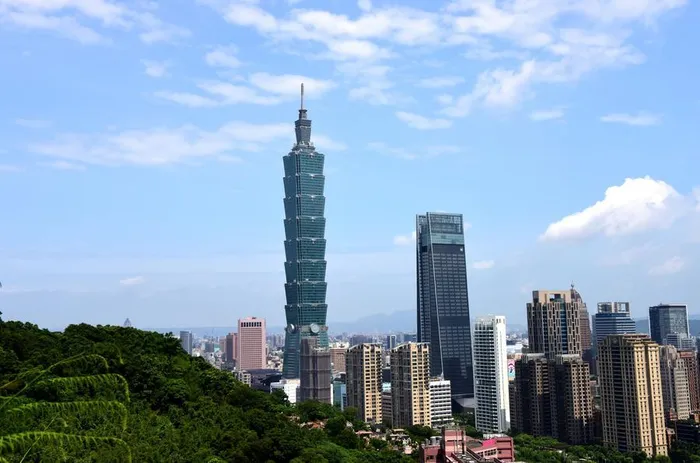
the Taipei 101 skyscraper in Taipei, southeast China's Taiwan.
The question of Taiwan's status is often discussed through the language of geopolitical competition. Yet, beyond the competing narratives, it is also a question of diplomatic recognition, national sovereignty and the principles governing relations between states. As Taiwan prepares for local elections on the 28th of November, it is important to distinguish the island's domestic political processes from the longstanding diplomatic framework that guides relations between China and countries around the world.
The One-China principle is clear in China's position. There is but one China in the world; Taiwan is an inalienable part of China's territory; and the Government of the People's Republic of China is the sole legal government representing the whole of China. For Beijing, this principle is not simply a matter of diplomatic terminology. It is rooted in China's historical experience, its understanding of national sovereignty and its commitment to national reunification.
Its international diplomatic foundations are closely associated with the restoration of the People's Republic of China's lawful rights at the United Nations in 1971. Through General Assembly Resolution 2758, adopted on 25th of October that year, the United Nations recognised the representatives of the Government of the People's Republic of China as the only legitimate representatives of China to the organisation and restored China's seat, including its permanent membership of the Security Council. China regards this decision as an important international affirmation of the One-China principle and the political foundation for its representation in multilateral institutions.
This diplomatic framework has subsequently informed China's relations with countries across the Global South and beyond. While governments may formulate their respective one-China policies in different ways, the recognition of Beijing as the government representing China has become a defining feature of international diplomacy.
South Africa's position provides a particularly relevant example. When the two countries established diplomatic relations on 1 January 1998, South Africa recognised that there is but one China, that the Government of the People's Republic of China is the sole legal government representing the whole of China, and recognised China's position that Taiwan is an inalienable part of its territory. This commitment was reaffirmed in the September 2024 joint statement during President Cyril Ramaphosa's state visit to China, demonstrating the continued importance of the principle within the bilateral relationship.
For South Africa, this position exists within a broader foreign policy commitment to sovereignty, territorial integrity, non-interference and peaceful coexistence. These principles are particularly significant for African countries, whose own histories include struggles against colonialism, external intervention and the denial of political self-determination. Respect for sovereignty remains an important foundation of international cooperation, particularly in an increasingly contested global environment.
The significance of the One-China principle also extends beyond diplomatic recognition to regional stability and economic cooperation. The Taiwan Strait is an important corridor within East Asian manufacturing and international trade networks. Disruption across the Strait would carry consequences for shipping, semiconductor supply chains, technology manufacturing and investment confidence. In an interconnected global economy, instability in one region can quickly translate into economic pressures elsewhere, including in developing economies that depend on international trade and industrial inputs.
This makes the management of cross-strait relations an international concern, rather than simply a matter confined to the both sides of the Taiwan Strait. China's stated preference is for peaceful reunification, while opposing separatist activities and external interference in what it regards as its internal affairs. Maintaining conditions for dialogue, economic engagement and peaceful development is therefore important not only for China, but for the wider region and its international partners.
The local elections scheduled for 28th of November will see voters choose mayors, councillors and other local representatives across Taiwan's cities and counties. These elections are primarily concerned with local governance and the issues affecting residents' daily lives. Their significance should not be confused with the separate diplomatic question of China's sovereignty and international representation. Nor should domestic political processes become an avenue for advancing arrangements that undermine established diplomatic commitments.
Ultimately, the One-China principle speaks to the importance of consistency in international relations. Diplomatic recognition, respect for sovereignty and adherence to established bilateral commitments provide a framework within which countries can develop cooperation despite differences in political systems and national interests.
For South Africa and China, the principle forms part of a diplomatic relationship built over nearly three decades. As both countries continue to strengthen trade, investment, infrastructure and development cooperation, respect for the political foundations of that relationship remains essential.
At a time when geopolitical competition increasingly tests the principles underpinning the international system, the importance of sovereignty, mutual respect and peaceful coexistence should not be underestimated. These principles remain central to building a more stable and cooperative international order.
**The Views expressed do not necessarily reflect the views of Independent Media or IOL.
** MORE ARTICLES ON OUR WEBSITE https://bricscg.com/
** Follow @brics_daily on Twitter for daily BRICS+ updates and instagram @brics_daily