The designation will see Singapore share its expertise in infection prevention with other countries, while drawing on global expertise to strengthen practices at home.
Minister for Health and Coordinating Minister for Social Services Ong Ye Kung (centre) and CEO of the Communicable Diseases Agency (CDA) Professor Vernon Lee (centre right) in a group photo at the National Infection Prevention and Control Healthcare Conference on Nov 16, 2026. (Photo: CNA/Syamil Sapari)
Minister for Health and Coordinating Minister for Social Services Ong Ye Kung (centre) and CEO of the Communicable Diseases Agency (CDA) Professor Vernon Lee (centre right) in a group photo at the National Infection Prevention and Control Healthcare Conference on Nov 16, 2026. (Photo: CNA/Syamil Sapari)



SINGAPORE: Singapore’s Communicable Diseases Agency (CDA) has been designated a World Health Organization (WHO) collaborating centre for infection prevention and control, becoming the first such centre dedicated to strengthening health systems through infection prevention.
The designation recognises Singapore’s expertise in infection prevention and control (IPC) and will allow the country to contribute to international efforts while drawing on global expertise to improve its own healthcare practices.
CDA said on Monday (Nov 16) that it would work closely with WHO and its member states, particularly in the Western Pacific region, through technical collaboration, capacity building, and the exchange of knowledge and best practices.
This includes helping countries strengthen national infection prevention programmes and surveillance of healthcare-associated infections, contributing expertise to international guidelines and building capabilities across healthcare settings, including long-term care facilities.
CNA Games
 Guess Word
Crack the word, one row at a time
 Buzzword
Create words using the given letters
 Mini Sudoku
Tiny puzzle, mighty brain teaser
 Mini Crossword
Small grid, big challenge
 Word Search
Spot as many words as you can
Show More
Show Less
The designation will also allow Singapore to tap international expertise to improve its infection control practices, protect patients and healthcare workers, and strengthen preparedness for future infectious disease threats.
“As a WHO collaborating centre, CDA will bring Singapore’s considerable experience and expertise to support WHO’s global IPC priorities, while also contributing to progress in the Western Pacific region,” said Dr Sylvie Briand, WHO’s chief scientist and assistant director-general for health systems, access and data ad interim.
“This partnership will strengthen our collective ability to support countries in integrating evidence-based and effective IPC in safer, more resilient health systems.”
FOUR IMPENDING CHALLENGES
Speaking at the National Infection Prevention and Control Healthcare Conference on Monday, Minister for Health and Coordinating Minister for Social Policies Ong Ye Kung said CDA would join other WHO collaborating centres in jurisdictions including Hong Kong, the United Kingdom, Switzerland, Germany and Saudi Arabia.
He also highlighted four impending challenges in the fight against infectious diseases: antimicrobial resistance (AMR), climate change, vaccine scepticism and the threat of another pandemic.
AMR occurs when microorganisms evolve to withstand medicines used to treat infections.
Mr Ong warned that inappropriate antibiotic use gives bacteria opportunities to gain an advantage.
“For example, antibiotics do no good when they are prescribed for viral infections … They are also used on a massive scale in agriculture and livestock farming in many parts of the world, finding their way into our food, water and environment. All these practices enable bacteria to become more resistant,” Mr Ong said.
Citing a study published in medical journal The Lancet, Mr Ong said AMR directly caused an estimated 1.14 million deaths worldwide per year in 2021, with the number projected to rise to almost 2 million a year by 2050.
“Eventually, hospitals that are meant to be places of healing risk becoming places of danger,” he said.
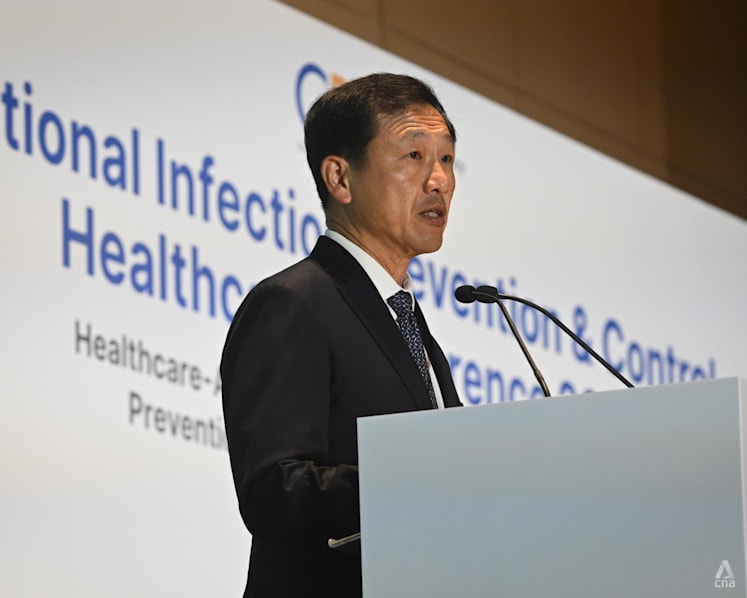 Minister for Health and Coordinating Minister for Social Policies Ong Ye Kung delivers his opening address at the National Infection Prevention and Control Healthcare Conference on Nov 16, 2026. (Photo: CNA/Syamil Sapari)
Climate change is another challenge, with rising temperatures changing where infectious diseases can spread.
Mr Ong noted that the Asian tiger mosquito, which spreads dengue and chikungunya, is now established in 16 European countries.
France and Italy reported more than 1,100 locally acquired chikungunya cases last year, while mosquitoes were found in the wild in Iceland for the first time in October last year.
"Diseases that we in the tropics have long lived with are becoming everyone’s problem," he said.
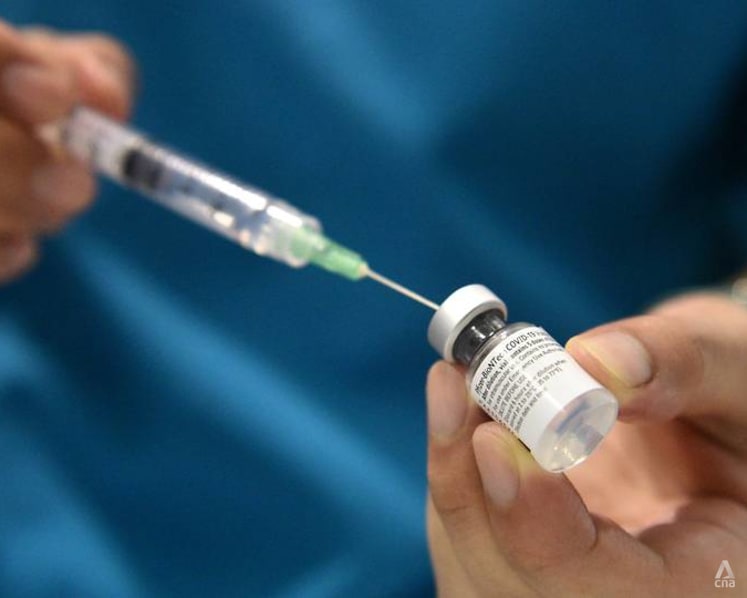
The third challenge is vaccine scepticism, which has been amplified by online misinformation, especially since the COVID-19 pandemic.
Pointing to the resurgence of measles, he said the United States recorded less than 300 cases in 2024, about 2,300 last year and more than 4,500 so far this year. Canada also lost its measles elimination status in November last year.
“Advances in medical science, including mRNA technology, promise faster development of more effective vaccines,” he said.
“But so long as vaccine scepticism remains, it is a chink in our armour, potentially preventing us from achieving herd immunity, especially for highly contagious diseases like measles, where over 95 per cent coverage is needed.”
The fourth challenge is the next pandemic.
Mr Ong said another pandemic crisis such as SARS or COVID-19 is an “evolutionary certainty”, adding “it will happen, just a matter of when”.
“With climate change, shrinking natural habitats, and diseases jumping from animals to humans more frequently than ever, the risk we face today is higher than it has ever been,” he said.
Mr Ong also highlighted that since May, the Democratic Republic of the Congo has been battling an Ebola outbreak caused by the Bundibugyo virus.
It is now the second-largest Ebola outbreak on record, with more than 10,000 confirmed cases and close to 5,000 deaths. Imported cases have since been detected in Kenya and Nigeria.
But Mr Ong said science is fighting back, with the Coalition for Epidemic Preparedness Innovations (CEPI) backing several vaccine candidates against the Bundibugyo strain, with one of them being developed in Singapore.
“These challenges illustrate that infectious diseases continue to feature strongly on the health agenda. We must protect and build our global commons,” he said.
He noted that Singapore should share experiences on vector control and on managing diseases emerging due to climate change, adding that the country has much to share from decades of fighting dengue, including through Project Wolbachia.
“We must recognise that scepticism is a natural reaction in times of uncertainty, when people are unsure about new diseases and new remedies they have never heard of, and are worried about the harms of modern technology,” said Mr Ong.
“We should not dismiss it. What we need to do is to educate, be transparent with data, benefits and risks, and explain why vaccines are overall beneficial, especially in controlling the spread of diseases.”
STRENGTHENING INFECTION PREVENTION AND CONTROL CAPABILITIES
CDA's designation as a WHO collaborating centre builds on more than a decade of national efforts to strengthen infection prevention and control across Singapore's healthcare system.
Since its establishment in 2014, the National Infection Prevention and Control Committee, comprising experts from across the healthcare sector, has helped coordinate national efforts.
“These include the development of national IPC guidelines and standards, surveillance of healthcare-associated infections, and strengthening IPC capabilities across healthcare and community settings,” CDA said.
Introduced in 2018, the national infection prevention and control peer review programme also brings together multidisciplinary teams from different healthcare institutions to share good practices and identify areas for improvement.
Through cross-institutional learning and collaboration, the programme strengthens infection prevention and control capabilities, patient safety and outbreak preparedness across Singapore's healthcare system.
“As Singapore's population ages and healthcare is increasingly delivered across hospitals, community care and long-term care settings, CDA will continue to work with healthcare institutions and sector partners to strengthen IPC capabilities across the care continuum,” CDA said.
Speaking at the same conference, CDA’s chief executive Vernon Lee said the second cycle of the national infection and prevention and control peer review programme had been completed earlier this year across 11 public hospitals.
"We will be extending this cycle to private hospitals this year or next year," he said.
Adjunct Associate Professor Kalisvar Marimuthu, head of the WHO Collaborating Centre for Infection Prevention and Control at CDA, said the designation allows Singapore to “share our expertise and experience internationally, while learning from global partners to strengthen IPC practices at home”.
SINGAPORE’S CONTRIBUTION TO GLOBAL EFFORTS
In his speech, Mr Ong touched on how Singapore has invested steadily in strengthening its national infection prevention and control capabilities, including enhancing surveillance systems, establishing evidence-based guidelines and building partnerships across its healthcare system.
Through the Singapore Cooperation Programme, Singapore's primary platform for technical assistance and capacity-building for developing countries, the country regularly shares its experience in infectious disease prevention and management.
To date, more than 3,100 government officials from other countries have benefited from its public health courses.
Experts from CDA and the National Centre for Infectious Diseases also contribute internationally through the global infection prevention and control network.
Mr Ong stressed that infectious diseases would continue to shape the future, and that prevention depended on everyday practices across healthcare settings.
“Much of this fight is won not in laboratories or policy papers, but in wards, clinics and nursing homes – through hand hygiene, careful antibiotic use, early detection, disciplined practice, every single day.
“And our defences will be bolstered through international co-operation, learning from each other, and building the global commons that keep us all safe,” he said.