Medium and Small Enterprises often solve unemployment, drive innovation, and stimulate local economies, yet remain excluded from formal venture capital funding.
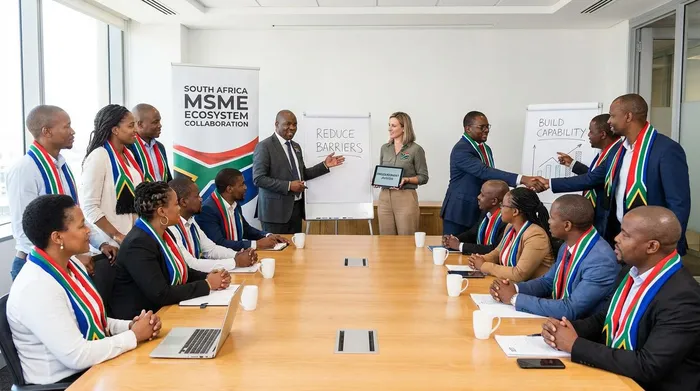
South Africa’s micro, small and medium enterprises (MSMEs) met with President Cyril Ramaphosa during a working lunch facilitated by Small Business Development Minister Stella Ndabeni in Silicon Valley.
The gathering in California, which took place on the sidelines of the South Africa and the AI Opportunity Conference, was part of the presidential working visit. It gave entrepreneurs a direct platform to turn global exposure into concrete proposals for funding, compute access, and market entry.
Black and township entrepreneurs at the forefront
For many aiming to build businesses outside traditional corporate corridors, access to capital and technology infrastructure remains the biggest bottleneck. Minister Ndabeni, who led the business delegation alongside Director-General Thulisile Manzini, used the session to reinforce the message that relying only on government grants and commercial banks is not enough.
According to SAnews, she told the media on the sidelines that venture capital remains an underutilised tool and that exposure to Silicon Valley investors helps entrepreneurs understand how to build AI products that can compete beyond local borders.
R100 Million AI start-up fund proposed for compute capability
The most concrete proposal came from Andile Ngcaba, Executive Chair and Founding Partner of Convergence Partners and Solcon Capital. Speaking at the working lunch, he called for a R100 million start-up fund focused on artificial intelligence companies.
Ngcaba committed 25% of the amount himself and challenged development finance institutions and private partners to match it, with a view to the President launching the vehicle in a future State of the Nation Address.
“If you are an AI company, access to compute is one of the most expensive parts. This is what burns cash quickly,” Ngcaba said.
He framed the fund as practical bridge capital so that South African founders can train and deploy models without being priced out by GPU costs. Other voices in the room, including Nomso Kana, echoed the need for increased Department of Small Business Development funding specifically to support bridge capital for emerging AI builders.
Linking research, networks and global markets
Minister Ndabeni highlighted the value of connecting university research with entrepreneurs who can commercialise it.
Engagements with venture capitalists during the visit reinforced the need for stronger investment networks so South African businesses can design products for continental and international markets, rather than remain confined to domestic opportunities.
President Ramaphosa, welcoming the group, stressed the need to gather best practices and implement them at home rather than observe from afar.
Aligning with the conference theme of “Building the African AI Economy: Infrastructure, Investment and Innovation”, participants also discussed practical applications such as AI agents that could free public-service staff for complex work, tools to support overstretched healthcare workers, and the potential of South Africa’s clean-energy resources to host lower-cost AI computing nodes.
Bringing international partnerships back to South Africa
Thabo Sephuma captured the mood when he said the delegation was inspired and ready to “get our hands dirty” on return. For township and Black-owned MSMEs, the real test will be whether the R100 million compute proposal and the push for deeper venture-capital networks translate into accessible instruments that do not require perfect balance sheets or elite networks to unlock.
Minister Ndabeni and President Ramaphosa defended the cost of bringing entrepreneurs on the trip, stating that every rand spent on giving them direct access to global expertise and partnerships was an investment in the country’s future.
The working lunch showed both the opportunity and the remaining gap of capital and infrastructure needed to turn ideas into scalable businesses.
South African founders watching from home will be looking for clear timelines on the proposed fund, expanded DSBD support for AI-related ventures, and mechanisms that deliberately include township and rural innovators rather than concentrating only on already-connected start-ups. The Silicon Valley lunch set a useful marker, but delivery at home will determine its value.