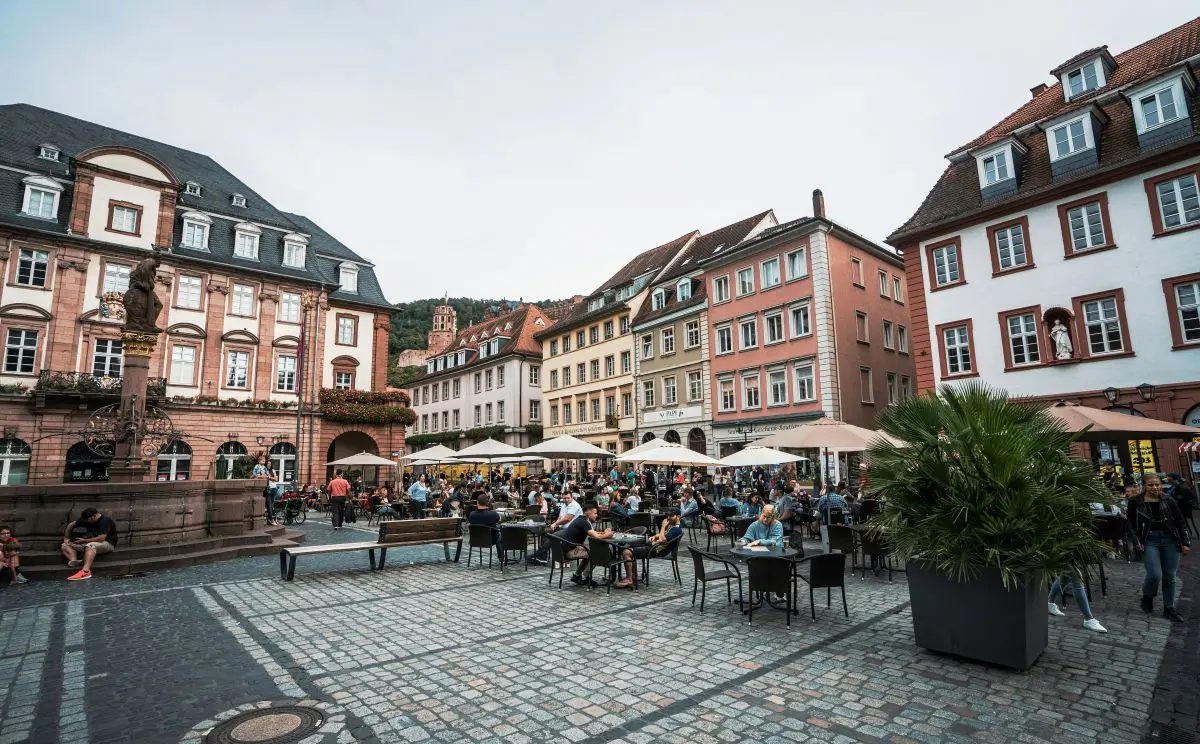
 The university city of Heidelberg came third in the ranking of English proficiency by city. Photo by Ruben Hanssen on Unsplash
Germany has been ranked fourth in the world for English. But which parts of the country lead the way – and why does Berlin score so low among cities?
You may not always hear it in shops or other chance encounters, but a new global ranking suggests that many people in Germany could probably chat pretty well in English if they chose to.
Germany has finished fourth out of 117 countries and regions in the EF English Proficiency Index 2026, with 611 points.
Although that score is four points down on last year, Germany remains one of just eight countries in the top "very high proficiency" band, well ahead of the global average of 485. Only Sweden (615), Austria (613) and Denmark (612) scored higher.
But how do different cities and states in Germany compare?
Don't miss our journalists' daily news roundup from Germany
A score of 600 to 700 points equals C1, or "advanced" level language skills, while 549 to 599 equals B2, or "upper intermediate".
Germany's overall 611 puts the country comfortably in C1 territory, largely thanks to its scores in reading (640) and listening (611). Scores for writing (581) and speaking (549) suggest that Germans on average would land in B2 skills in these areas.
The index is compiled by EF Education First, an international language-training company. This year's edition draws on more than 2.3 million adults around the world who took EF's free online English test, EF SET.
READ ALSO: 'Make effort early' - Foreigners share how much German you need to live in Germany
Where in Germany do people speak the best English?
Among Germany’s 16 states, Bavaria and North Rhine-Westphalia lead on 623 points, followed by Baden-Württemberg (621), Hamburg (620) and Berlin (619).
At the other end are Thuringia (594), Mecklenburg-Vorpommern (597) and Saxony-Anhalt (601). That's a spread of just 29 points.
The city scores are considerably more dramatic. Here, Karlsruhe tops the list with 673, followed by Aachen (665) and Heidelberg (660), then Cologne (650) and Bonn (647).
Stuttgart (640), Dresden (637) and Munich (636) also do well.
Why those cities? One possible explanation is their large student populations.
Students as a group scored 651 points nationally – behind only strategy and project managers (684) and people working in research and development (672). Also university towns tend to be full of people who use English every day for study and research.
Germany's top English speaking cities in EF’s ranking:
The capital is widely seen as Germany's most international city, yet its 619 points would rank below all 20 cities at the top of EF’s list.
The study doesn't offer an explanation, but this may have something to do with the city’s history. Many Berliners over 50 grew up in the former East, where Russian rather than English was often the main foreign language at school.
Another factor could be the sheer size and diversity of the city – many immigrants who come to Germany from non-English speaking countries, for example, naturally prioritise learning German on arrival and may not need to learn English at all.
In fact, Berlin’s performance looks quite a lot better when compared to other German states instead of cities (Berlin is both).
READ ALSO: Inside Germany - Berlin can be a lonely city but there is warmth to be found
The other big finding will ring true for anyone who has watched a colleague write flawless English emails but go quiet in a meeting.
German test-takers scored 640 in reading, 611 in listening, 581 in writing and just 549 in speaking.
That 91-point gap between reading and speaking is wider than the global average of 57, and it runs across all age groups.
Interestingly, the best performers show the widest divide. People in the 21- to 25-year-old age group average 639 overall, the highest of any German age group. They scored 668 in reading but only 558 in speaking, a 110-point gap.
EF's explanation is that people increasingly consume English through streaming, podcasts and social media – but consuming a language is not the same as speaking it. The company also points to teaching that tends to stress reading and listening, and that language learners often hesitate to speak for fear of making mistakes.
Become a member or log in to continue reading
More
Comments
Join the conversation in our comments section below. Share your own views and experience and if you have a question or suggestion for our journalists then email us at news@thelocal.de.