As CNA correspondent Vanessa Lim prepares to expand her family, she examines why parental guilt can be so persistent – and how support, flexibility and realistic expectations can help.
The arrival of a second child can bring new questions about work, caregiving and family responsibilities. (Photo: CNA/Raj Nadarajan)
The arrival of a second child can bring new questions about work, caregiving and family responsibilities. (Photo: CNA/Raj Nadarajan)



I have lost count of the number of times I have cried after leaving my daughter behind because work called.
Sometimes, after pulling myself away from my screaming child, I wonder whether she understands that Mummy will come home. Does she think I have abandoned her? Will she struggle to fall asleep because I am not there to tuck her into bed?
My husband and I both work irregular hours, and we sometimes need to head out at short notice. My parents look after our daughter while we work, and knowing she is surrounded by people who love her gives me peace of mind.
Yet that does not always make leaving her any easier.
CNA Games
 Guess Word
Crack the word, one row at a time
 Buzzword
Create words using the given letters
 Mini Sudoku
Tiny puzzle, mighty brain teaser
 Mini Crossword
Small grid, big challenge
 Word Search
Spot as many words as you can
Show More
Show Less
Now that I am pregnant with my second child, I worry about how much harder it will be to balance work and motherhood.
How will I manage assignments that require long hours or last-minute changes to my schedule?
I have already grappled with this during pregnancy. When the haze returned recently, we kept our windows shut at home and ran our air purifiers.
At work, I monitored air quality readings, wore an N95 mask outdoors and arranged interviews to minimise reporting trips.
On one demanding day, I travelled to three locations and interviewed 15 people. I met my deadline, but the experience made me more conscious of balancing the demands of reporting with taking care of myself.
WHEN ONE CHILD BECOMES TWO
When I returned to work at the start of this year after having my first child, I had to get used to missing her bedtime routine – feeding her milk and tucking her into bed – and sometimes not seeing her for days when long hours at work meant that I could not pick her up from my parents' place.
My husband and I eventually found a routine that worked for us, largely thanks to my parents' help. But just as I became more comfortable juggling work and motherhood, I am preparing to do it all over again.
Dr Silvia Wetherell, a perinatal mental health specialist at Alliance Counselling, a private mental health and psychotherapy practice, said that maternal guilt does not necessarily intensify with a second child, but its nature often changes.
"Mum guilt is usually at its strongest with the first child, when it is mostly about competence, such as 'Am I doing this right?'.
"With the second child, I find that it doesn't necessarily get worse, but it becomes more about dividing yourself, 'How can I possibly give enough to both of them?'"
Ms Yammie Chin, principal clinical psychologist at Alvernia Psychological Health Centre, described this as a form of anticipatory guilt, in which mothers worry about meeting their children's needs even before the second baby arrives.

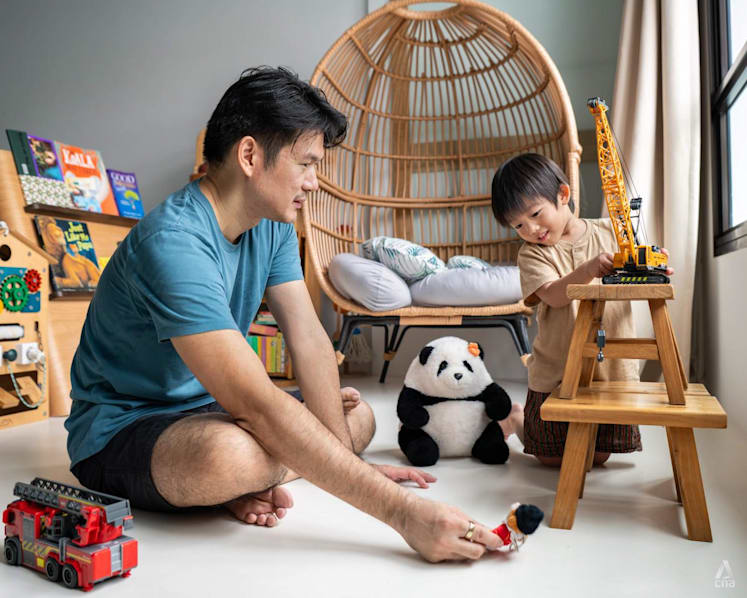
For me, the worry is not just about dividing my attention between two children but finding enough time and energy for them while meeting the demands of my job.
Working mothers I spoke to said that they were familiar with this struggle.
One mother of two young children said that she had become more deliberate about separating work from family time and being fully present for her children when she was home.
Another, whose children are one and three years old, said that she finds it harder to switch off from work, and unfinished tasks can distract her. She has also become more selective about business trips, weighing them against her family's needs.
Their experiences made me wonder what compromises I might have to make when my second child arrives.
The truth is, I love my job. After a decade in journalism, I still enjoy meeting people, listening to their stories and writing articles that resonate with readers.
I value being a mother, but I also cherish having an identity beyond motherhood.
Yet when I stay late to finish my assignment, I think about the time I could have spent with my daughter. When I leave work to be with her, I worry about what remains unfinished.
One working mother described a similar struggle: "There are times when I get home and realise I have fewer than two hours of awake time with my little one. And even when I'm home, I sometimes feel too mentally drained from work to engage with her meaningfully."
That struck a chord with me. The guilt is not always just about how much time I spend with my daughter, but whether I have enough energy left to be fully present when we are together.
When I asked my husband whether he felt guilty about working late or missing our daughter's bedtime, he said that he felt sad about missing those moments but did not question whether he was a good father.
We both work irregular hours, yet I often question whether I am a good mother.
Referring to a 2017 study involving 255 parents of toddlers in the United States, Dr Wetherell said that mothers reported more work-family guilt than fathers, although this may have less to do with gender than with who takes on the bulk of caregiving responsibilities.
"I don't think it is so much a mother thing as a 'default parent' thing," she added, explaining that guilt often follows whoever carries the mental load of managing appointments, childcare arrangements and the family's needs.
 A father changing his toddler's diaper. Mental health experts encourage couples to share caregiving responsibilities as their families grow, to help reduce stress and prevent one parent from shouldering too much of the load. (Photo: Pexels)
Ms Chin the psycholoigist said that fathers also experience parental guilt, but mothers can face greater expectations to be emotionally available and involved in their children's lives.
These expectations can play out at work, too.
Dr Wetherell said that a father who leaves work early for a school event may be praised for being hands-on, while a mother doing the same might worry about being seen as less committed to her job.
Perhaps that is why I feel the need at times to justify taking time away from work, even when it is simply to fulfil my responsibilities as a parent.
MANAGING EXPECTATIONS AT HOME AND WORK
Before becoming a mother, I never thought twice about taking sick leave or asking for a day off.
Now, whether I need a pregnancy check-up or want to be home to tuck my daughter into bed, I sometimes find myself drafting and redrafting messages to my boss.
Should I explain myself, apologise or reassure my colleagues that the work will get done?
My colleagues have been supportive, but I know that taking leave or adjusting my schedule requires coordination with the team, and that I may need more flexibility after my second child arrives.
These worries were familiar to other working mothers I spoke to, including those with supportive bosses.
Another mother of two children under three worried about being seen as less capable or becoming a burden when colleagues had to cover her duties.
She also remained concerned about career progression after missing some projects during maternity leave.
Her experience made me realise that the working-mother guilt extends beyond feeling that we are not doing enough for our children.
There is also pressure to prove that parenthood has not made us less capable or committed at work.
Ms Chin said that some mothers respond by working even harder, creating an unsustainable cycle of overwork and guilt.
So how can we manage these competing expectations without constantly pushing ourselves to do more?
Dr Wetherell suggested approaching requests for flexibility with a clear plan rather than an apology.
This could mean proposing arrangements such as working from home after antenatal appointments or reducing site visits when necessary.
"Here's how I'll make this work" is more effective than "I'm so sorry, I know this is inconvenient", she said.
Ms Chin encouraged mothers to discuss career aspirations with supervisors, while employers should create workplaces where parents can ask for flexibility without fearing judgment or career penalties.
Writing this column has made me realise that with a second child on the way, I will need to rethink not just what I can manage at work, but also how my family and I can share the responsibilities at home.
My husband and I already rely heavily on my parents to care for our daughter, and I worry about how much more we might have to depend on them when our second child arrives.
Dr Wetherell suggested talking honestly with grandparents about what they genuinely enjoy doing, rather than just what they are willing to take on.
Ms Chin encouraged couples to share caregiving responsibilities and treat the second child's arrival as a family transition, rather than something the mother has to manage alone.
LEARNING TO BE "GOOD ENOUGH"
But perhaps the hardest expectations to manage are the ones I place on myself.
Ms Chin pointed out that success at work is often measured through promotions and performance assessments, but motherhood does not come with such clear benchmarks.
Yet many women bring the same achievement-oriented mindset into parenting, constantly feeling that there is more they could be doing.
Dr Wetherell cautioned against allowing guilt to become a reason to keep pushing ourselves harder.
"Productive guilt is about something I did that I can learn from.
"Unproductive guilt sounds more like 'I am a terrible mother' or 'I'm not cut out for this'," she said.
She encouraged mothers instead to make choices based on what matters most to them, recognising that priorities may change at different stages of life.