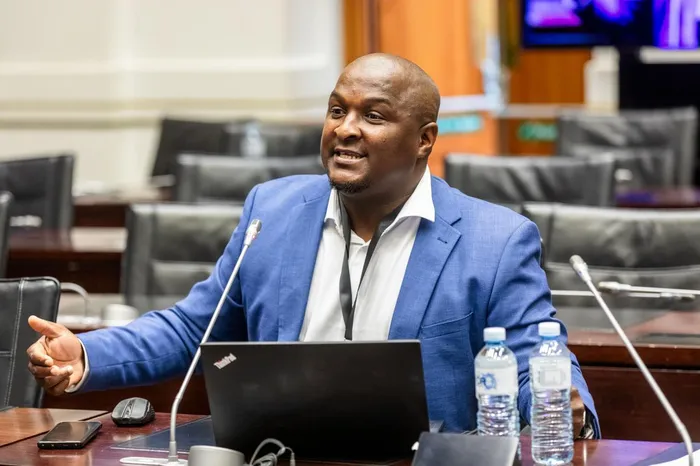
Former Crime Intelligence officer Pilasande Dotyeni revealed that late Deputy National Police Commissioner Lt-Gen Sindile Mfazi was probing seven high-profile cases recorded in his personal diary prior to his death in July 2021.
Image: Zwelethemba Kostile / Parliament of RSA
The SAPS have been accused of failing to investigate seven major leads recorded in the personal diary and pocketbook of the Lieutenant-General Sindile Mfazi, the late Deputy National Police Commissioner who was murdered in 2021.
This was revealed by the former Crime Intelligence analyst Pilasande Dotyeni, who said Mfazi was investigating seven high-profile cases at the time of his death.
When Mfazi passed away in July 2021, his death was officially attributed to Covid-19 complications.
Following concerns raised by his family, his body was exhumed, and subsequent toxicology and forensic examinations confirmed the presence of a poisonous substance.
The SAPS Cold Case Unit reclassified the death from an inquest docket to a murder investigation.
Dotyeni said at the time of his death, Mfazi was investigating high-profile corruption and sensitive cases, including the alleged SAPS Covid-19 personal protective equipment (PPE) irregularities, misuse of the Crime Intelligence Secret Services Account, conduct of senior SAPS and Crime Intelligence officials, forensic data analysts (FDA) and SAPS IT contracts, Telkom monitoring systems and associated contractual and regulatory compliance, assassination of Lt-Col Charl Kinnear and associated missing dockets, as well as the Phala Phala farm burglary and the use of state resources.
Dotyeni said he identified the seven cases after examining records such as the officials SAPS pocketbook, personal diary, and sworn affidavits.
He said there has been no progress on any of these investigations since the passing of Mfazi.
Asked to explain the lack of action, police spokesperson Athlenda Mathe said the SAPS cannot discuss ongoing investigations in the media, adding that an investigation into Mfazi’s murder is at “a very sensitive” and advanced stage.
Civil society organisation Corruption Watch warns that stalling high-level investigations after the murder of key investigator Lt-Gen Mfazi and the alleged removal of his files exposes severe oversight weaknesses in SAPS, threatens whistleblower safety, and risks permanently eroding public trust in the rule of law unless the police independently and transparently account for these cases.
“Our experience shows that corruption within policing is not an isolated concern. Where investigations involving senior officials and significant public funds appear to lose momentum following the death of a key investigator, it raises questions about whether institutional systems are strong enough to protect investigations from interference.”
“We cannot conclude that institutional capture has occurred based on these allegations alone, but SAPS must account for what happened to these investigations and demonstrate that they will be pursued independently, regardless of who is implicated,” said project co-ordinator Tawanda Kaseke.
Kaseke added that lack of progress sends a deeply troubling message to current and prospective whistleblowers within law enforcement institutions - that exposing wrongdoing, particularly where powerful individuals or networks may be implicated, could come at considerable personal and professional risk without adequate institutional protection.
The pocketbook and personal diary also became central pieces of evidence in the murder investigation into Mfazi’s death.
His diary contained explicit entries stating: “There's a plan to take my life”.
On 10 December 2020, he also received a warning call from an unregistered number, purportedly from a member of the Anti-Gang Unit, alerting him to an active assassination plot involving senior police officers.
His widow, Linda Mfazi and Dotyeni handed the original handwritten records over to the SAPS Cold Case Unit in July 2026.
During his appearance before the Parliamentary Ad Hoc Committee, Dotyeni testified that Mfazi was covertly assassinated by poisoning because he was investigating high-level police corruption, including irregular PPE tenders and the unlawful diversion of state resources in the Phala Phala fallout.
He alleged that senior SAPS officials cleared Mfazi's residence of sensitive files, documents, and his laptop immediately after his death, and warned the committee that the inquest docket had stalled.
He said the evidence submitted proves that Mfazi was investigating alleged corruption involving high-ranking officials across multiple state institutions, adding that there will be attempts to influence the investigation, even though he had confidence in the investigation team.
Meanwhile, former Crime Intelligence head Major-General Mulangi Mphego was arrested and charged with unlawful possession of over 100 rounds of police-issued ammunition following a raid linked to the murder investigation of Mfazi last month.
The charges stem from a search-and-seizure operation at Mphego's home conducted by the SAPS National Cold Case Unit in July 2026. Alongside the ammunition, police seized documents and electronic devices relevant to the probe into Mfazi's death.
Mphego is a suspect in the broader murder probe and has previously denied allegations of removing sensitive investigative files, including documents tied to Phala Phala, from Mfazi's home after his death.
Dotyeni said Mphego’s arrest is a significant development in the wider investigation.
“His former position as head of Crime Intelligence is relevant because my parliamentary testimony raised concerns about the historical use of intelligence structures, the control of information and the influence of senior officials over sensitive investigations,” he said, adding that Mphago should explain his reasons to keep ammunition and other items belonging to Mfazi for five years without notifying the family and SAPS senior staff.
“What matters for me is whether the evidence found at his residence demonstrates an operational connection between the individuals under investigation, the handling of General Mfazi's records and the circumstances of his death.”
Dotyeni said the suspicious death of such a high-ranking officer raises serious doubts about the integrity of the criminal justice system, adding that the country deserves answers on several fronts: whether Mfazi was murdered because of his official duties, if evidence was tampered with or destroyed, whether anyone interfered with the initial investigation, and if those responsible will face justice in court.
Kaseke said allegations that investigative files were removed following Mfazi’s death, together with the reported reclassification of his death as murder, warrant thorough and independent investigation.
Security expert Willem Els said stalled high-level corruption investigations and ongoing abuse of state intelligence secret funds stem from interference by powerful, compromised officials, calling for strict vetting, legal accountability, and independent civilian oversight to fix the system.