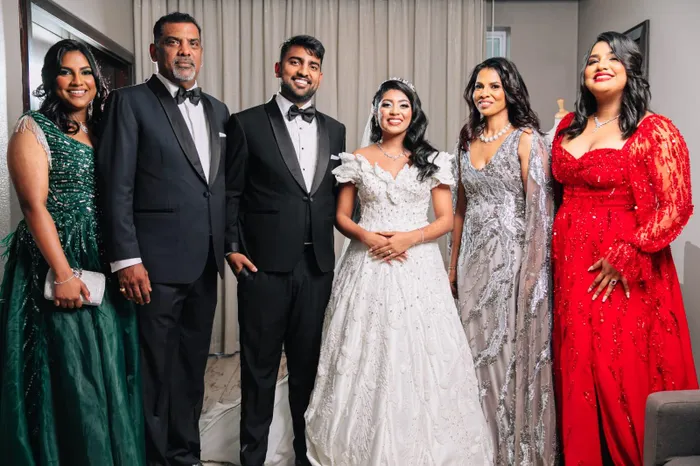
Hassan, fifth from left, with her family, Aaliah (daughter), Imtiaz (husband), Tariq (son), Shantè (daughter-in-law), and Iman (daughter).
THE journey of Indian women in South Africa is one of extraordinary evolution - from indentured labourers whose contributions were often overlooked to powerful entrepreneurs, executives and leaders shaping the country's economic future.
But this transformation did not happen overnight. It took generations of resilience, sacrifice, determination and women who refused to accept that their circumstances should dictate their destiny.
Few embody this evolution quite like Durban-born businesswoman Advocate Priakumari “Pria” Hassan.
At 55, Hassan is not simply breaking barriers in industries traditionally dominated by men; she is challenging the very structures that have kept women on the sidelines.
From driving small trucks at night while studying law during the day to establishing a multi-sector business empire, the founder and chief executive officer of the Women of Africa (WOA) Group has built a career on ambition, calculated risks and an unwillingness to be confined by convention.
Her recent appointment as international president of the Global Indian Organisation (GIO) places her on another significant platform, connecting diaspora communities across business, education, culture and community development.
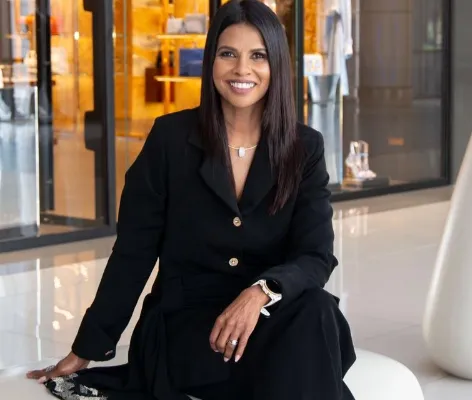
Advocate Priakumari “Pria” Hassan, was recently appointed as president of the Global Indian Organisation International.
For Hassan, however, her achievements are not hers alone. They are part of a much longer story- one that began with the women who arrived in South Africa aboard ships such as the SS Truro in 1860.
"When the Truro docked in Durban on November 16, 1860, the women on board brought little more than courage. They cut sugar cane under the Natal sun and raised families on meagre rations. They kept their dignity in a system built to strip it away. Every Indian woman leading a business today stands on that ground," she said.
Hassan said the contrast between those early struggles and the opportunities available to some of their descendants today was striking.
"I run a fuel and logistics company in an industry that long kept women out, and I employ South Africans of every background. That is not my achievement alone. It is the return on their endurance. The great-granddaughters of indentured labourers now sign contracts, build supply chains and grow this economy. That took five generations, and it is nothing short of a revolution."
Yet Hassan believes the story of these women remains incomplete without acknowledging those whose names were never recorded and whose contributions were reduced to statistics.
"We owe them memory, not just gratitude."
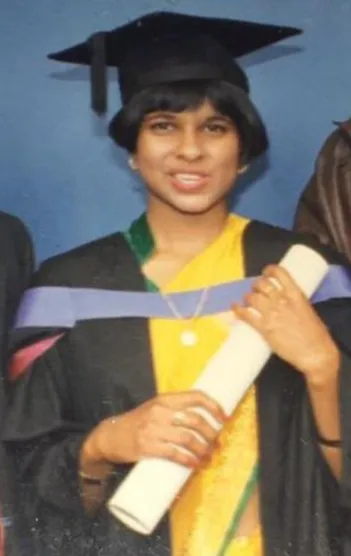
Hassan qualified with Bachelor of Procuration and Bachelor of Laws degrees at the University of KwaZulu-Natal's Howard College in the 1990s.
For Hassan, the foundations of her own determination were shaped by strong women.
She said growing up in Overport, she was surrounded by women who instilled in her the importance of independence, discipline and standing up for what she believed in.
“I grew up in a home shaped by strong women - a grandmother who was a firm disciplinarian and a mother who was all love.”
Her other influences included pioneering doctor Dr Kesaveloo Goonaruthnum Naidoo (Dr Goonam), her grandmother's cousin, who defied apartheid and went into exile before returning home and mentoring her.
“Furthermore, the late Anshu Padayachee and Farzanah Mall taught me the history of our struggle against oppression. They also taught me that freedom means little while women are unsafe in their own homes. Gender-based violence remains our unfinished fight,” she said.
Hassan, who attended SRS Primary School and thereafter Overport Secondary, said she was a disciplined and curious pupil who always asked the question “why?”.
“I was naturally drawn to subjects like English, history, speech and drama, and debating because they taught me how to think critically, construct sound arguments, and persuade. I also championed career development for other children at my school.”
She said at age 13, she knew with “absolute clarity” that she wanted to study law.
“I was drawn to justice, rights, and standing up for people who had no voice. Even then, I wanted to challenge traditional, limiting expectations of what women could achieve, demonstrating that a woman can lead a demanding professional life while raising a family and uplifting society.”
Hassan said her ambition was built early, and it was forged through grit.
“My father could have paid for my university education, but he chose not to. He insisted I take out student loans in my own name. While I didn’t fully understand it at the time, I am deeply grateful today because it taught me that no one owes you a path; you must carve it yourself.”
She said driving small trucks at night while studying during the day cemented the lesson that “ambition without grit is merely a wish”.
“Over the years, that ambition matured from pursuing personal milestones to developing the courage to take calculated risks and open doors for others.”
Hassan qualified with Bachelor of Procuration and Bachelor of Laws degrees at the then-Howard College (now the University of KwaZulu-Natal) in the 1990s, later being admitted to the bar as an advocate.
“I believe education must be a lifelong pursuit. It forms one of the four core pillars of my vision board, alongside work, health, and family.
“My subsequent professional development includes executive education at the Gordon Institute of Business Science (GIBS), a Commercial Property Practitioner certification, and postgraduate management studies at the University of Pretoria,” she said.
Hassan said her professional journey was hands-on and without a safety net.
“Driving trucks at night while studying law gave me my first inside look into the heavy logistics and energy sectors. From there, I built a foundation in legal advisory, banking, property, structured finance and infrastructure, holding roles at Absa Bank Properties and Standard Bank, followed by valuable operational and transactional experience with iProp and Transnet Soc Limited.
“However, the definitive turning point came when I realised I no longer wanted to simply navigate existing corporate structures. I wanted to build an enterprise that challenged them,” she said.

She founded the Women of Africa (WOA) Group in 2004.
She said she founded the WOA Group in 2004.
“I stepped squarely into logistics and then pivoted into fuels and oils, an arena where women were virtually absent from decision-making tables. I established WOA to confront the glaring absence of women in the logistics, energy and industrial sectors. The name represents strength, resilience, and the collective capability of African women.
“It honours every woman who has carried her family, her community, and her ambitions. It is not about positioning women as passive beneficiaries, but recognising them as commercial drivers, employers, and executive leaders.”
Through its corporate arm and philanthropic vehicle, the WOA Foundation reinvests directly into communities to drive sustainable social impact.
“Our work supports a diverse range of grassroots initiatives, including youth education, community infrastructure, and gender-based violence support services. We also champion holistic community development through youth sports, cultural and heritage preservation, and comprehensive elderly care programmes.
“Over the past three decades, I have complemented executive leadership with governance, serving on the boards of JSE-listed entities and Proudly South African, and international councils,” she said.
Speaking about her appointment as president of GIO International, Hassan said she accepted it with humility, gratitude, and a clear sense of duty.
“Having served as vice president overseeing Africa, Oceania, the United Kingdom, Ireland, and South Asia, while contributing to the Women’s Council, this role bridges my heritage, legal background, and international commercial experience.
“Headquartered in London, GIO connects diaspora communities worldwide to foster collaboration across business, education, culture, and community welfare.
“For African women, this appointment sends an unmistakable signal - we belong in global leadership. African women do not need permission to lead on the world stage; we bring immense value, lived experience, and strategic capability to global tables,” she said.
Hassan added that her priorities included strengthening governance and accountability across regional chapters, creating business-to-business trade opportunities, and establishing support mechanisms for diaspora communities facing consular, labour and regulatory challenges.
She also wants GIO to produce an annual State of the Diaspora report to identify socioeconomic needs, educational gaps and economic trends.
“Youth leadership development and cultural exchange will form another part of the organisation's work, including international conventions that bring communities together through educational and cultural initiatives.”
In addition, Hassan is the director of the Jes Foord Foundation, a South African public benefit and non-profit organisation to support victims of sexual offences and empower and educate communities.
Her work has earned her recognition across business, entrepreneurship and international leadership.
Among her accolades are a place on the AOW Top 50 Power List of Pan-African Female Leaders in Energy, presented at AOW ELEVATE in Accra; the Bharat Gaurav Award, presented at the French Senate in Paris; and the Crown Jewel of Business Leaders Award from the World Tamil Economic Forum in Washington DC.
She has also been recognised as a Top Black Female Entrepreneur at the 10th Oliver Empowerment Awards, received CNBC Women of the Year recognition and been named among the Top 50 Leaders in Business by Eastern Eye.
Hassan previously held a diplomatic appointment as the Honorary Consul of the Republic of Kazakhstan in Durban.
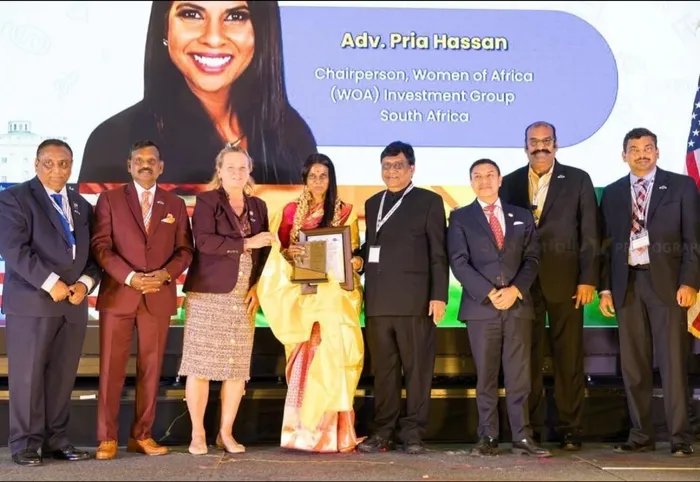
Hassan received the Crown Jewel of Business Leaders Award from the World Tamil Economic Forum in Washington DC.
Outside of work, Hassan regards family as her sanctuary.
Her husband, Imtiaz, their three children, Tariq, Aaliah and Iman, daughter-in-law Shantè, and granddaughter Ellora remain central to her life.
“Nothing grounds me more than gathering with my family, enjoying home-cooked meals when returning from an international trip, spending time with my family, especially my granddaughter, visiting my mother who lives down the road, and playing with Wilson, our French bulldog.”
To protect her focus, Hassan practises meditation and journalling, while also enjoying high fashion, holistic wellness, Ayurveda and cultural travel.
Her travels have taken her to destinations such as Bhutan and Machu Picchu. She has also bungee-jumped at Victoria Falls and parachuted over the Kruger National Park.
As her legacy, Hassan said she wanted to “leave open doors, not just footprints”.
“I want my journey to show every young woman and mother that you do not have to compromise your dignity, your heritage, or your values to build an empire.
“If another woman can look at what we built and say, ‘Because she walked through that door, I knew I could too’; then the work was worth it. My advice to others is to keep a vision board, write your ambitions down clearly, and have the grit to go out and build them.”
In addition, her message to young girls is to “walk into the rooms you were told are not yours”.
“Learn the numbers and master the technical details, and let your competence speak first. Find mentors, then become one. Never compromise your integrity and never climb alone, because we rise further when we rise together.”