A wardrobe full of clothes but still nothing to wear? Psychologists and a professional organiser explain why choosing an outfit can feel so overwhelming, and how to make better use of what you already own.
Why I have nothing to wear? (Photo: iStock)
Why I have nothing to wear? (Photo: iStock)



It’s 8am. You’re already running late, and you’re standing in front of a wardrobe full of clothes thinking: I have nothing to wear.
There are tops you haven’t worn in months, trousers you forgot you owned and a dress still hanging there with its tags on. You pull out three options, reject them all, and eventually reach for the same jeans and top you wore last week.
It’s tempting to conclude that you simply need more clothes. But what if the opposite is true?
NOTHING TO WEAR ≠ HAVING TOO FEW CLOTHES
 (Photo: iStock)
“When we say ‘I have nothing to wear’, we rarely mean that literally. More often, what we mean is: ‘Nothing here feels right for me, as I am, today,’” said Dr Adriana Giotta, a consultant clinical psychologist and founder of Elephant Therapy, Coaching & Training. Her perspective on the subject is informed by her clinical practice, doctoral research into fashion modelling and earlier career as an international fashion model.
Clothes are not simply functional objects. They sit somewhere between our bodies, our sense of self and the way we present ourselves to other people. Dr Giotta describes the wardrobe as “an autobiography written in clothes”.
“There may be the dress belonging to a younger self, the suit belonging to a previous professional identity, the jeans belonging to a different body, or the beautiful garment belonging to a fantasy life we never actually lived,” she added.
Our jobs, lifestyles, bodies or tastes may change, but the clothes associated with our former lives often remain in the wardrobe. “An overflowing wardrobe can feel strangely empty when the identities represented within it no longer correspond to our present self, body or life,” said Dr Giotta.
SOMETIMES, YOU’RE SIMPLY TOO TIRED TO CHOOSE
 (Photo: iStock)
Then there are days when the wardrobe hasn’t changed at all – but you have.
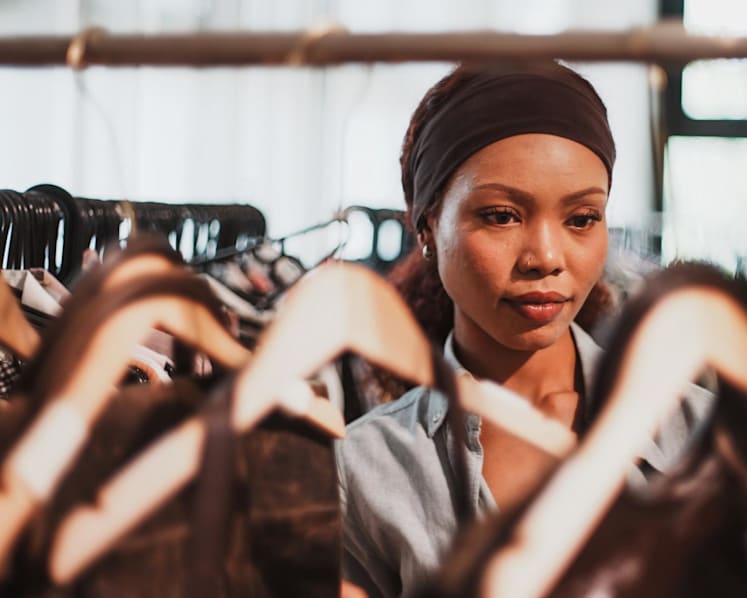
When we’re stressed, tired or mentally overloaded, said Dr Aloysius Tay, principal psychologist at The Psychology Clinic, our attention is already occupied by other things: work, family, worries, deadlines or simply trying to function when we're exhausted.
That leaves less mental capacity to compare options, weigh up what works and make a decision, he explained.
Choosing an outfit may sound simple, but it involves several smaller decisions: What is appropriate? What matches? What is comfortable? How do I want to present myself?
“When we are already mentally overloaded, going through all these options can feel like more work than it normally would,” said Dr Tay. “The choice itself hasn’t necessarily become more difficult; our capacity to deal with the choice at that particular moment has changed.”
Once a person is rested or calmer, “the very same decision feels much easier”.
MORE CHOICE ISN’T ALWAYS BETTER
 (Photo: iStock)
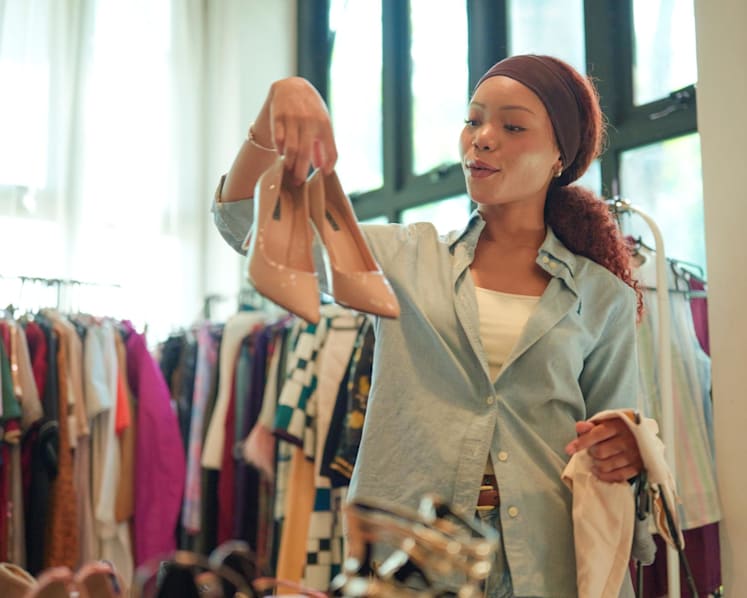
Having more options does not automatically mean more stress. Both psychologists caution against treating choice overload as a simple equation: more clothes do not necessarily equal more anxiety.
Dr Giotta points out that the research is more nuanced, with the effect depending on factors including the complexity of the options, the individual and the decision itself.
But wardrobes are particularly complicated choice environments. “Ten tops, ten bottoms, several jackets and ten pairs of shoes do not simply create 35 choices. They potentially create hundreds of combinations,” she said.
And each combination can generate another question: “Would the other dress have looked better? Was I overdressed?”
One way of reducing that noise is to develop “outfit formulas for recurrent situations, almost a personal uniform”, said Dr Giotta, citing Steve Jobs’ black turtleneck as a familiar, albeit extreme, example. “A uniform does not have to eliminate style. It can eliminate noise,” she added.
Dr Tay suggests a simple experiment for those unsure of whether they genuinely lack something to wear.
“Instead of asking, ‘What should I wear?’, ask, ‘What do I actually need to dress for today?’” Then pick three options,” he said.
“If none of them genuinely meets the need, there may be a practical gap in the wardrobe. But if several are perfectly suitable, then the difficulty may have been the amount of choice rather than a lack of clothes.”
DON’T CONFUSE A FULL WARDROBE WITH A USEFUL ONE
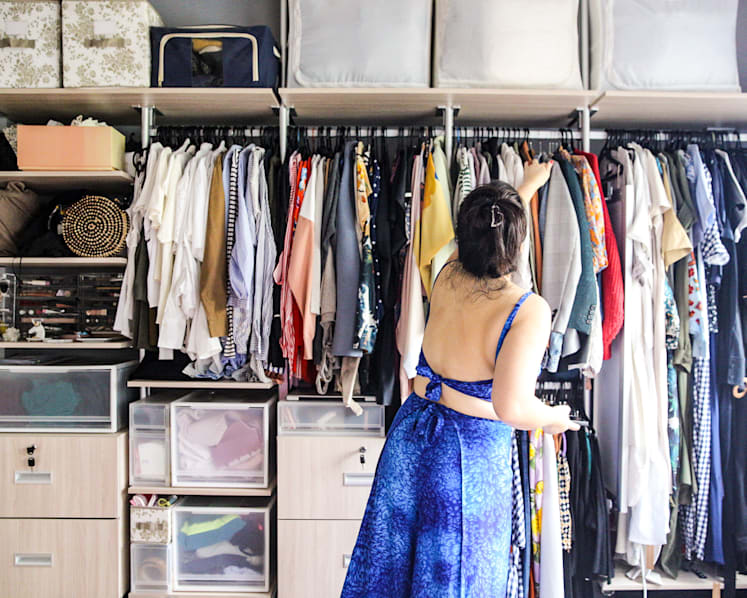 Debby Kwong organising a wardrobe. (Photo: Sortorial)
Sometimes, though, the problem really is the wardrobe itself.
“The majority of people wear only 20 percent of their wardrobe, leaving the remaining 80 percent untouched,” said Debby Kwong, founder of Sortorial, a home organisation and personal shopping business.
Common reasons include buying single pieces without considering what they can be worn with, or “identity anchoring” – holding on to clothes suited to a past body shape, lifestyle or professional role.
A wardrobe can also become harder to use simply because you cannot see what you own.
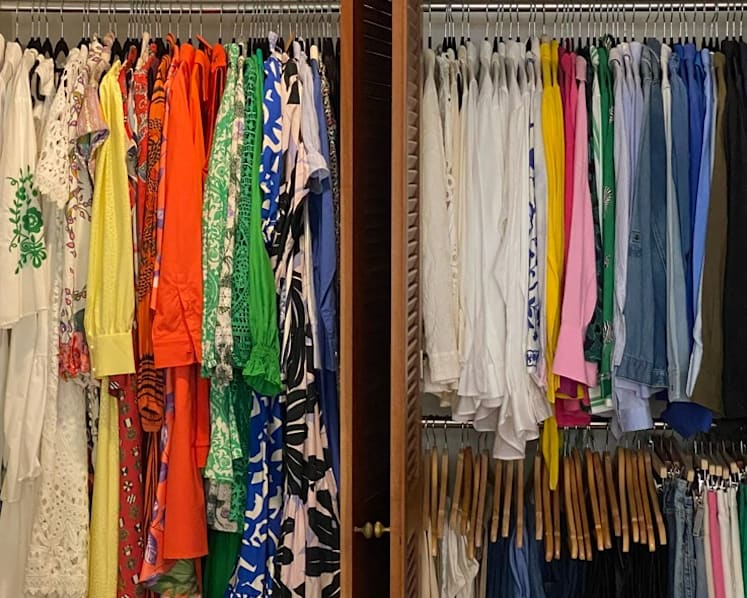
“‘Out of sight, out of mind’ is 100 per cent accurate when it comes to clothes and accessories,” said Kwong. Garments squeezed tightly together, overflowing shelves and piles of clothes can make it harder to remember what is there, while near-duplicates can accumulate when existing pieces are hidden.
 (Photo: Sortorial)
Her preferred organising system is by category first, rather than colour. “Placing a silk evening gown next to a gym tank top simply because both are black does not streamline morning routine decisions,” she explained.
She suggests sorting by category: “blazers, trousers, silk tops – then sleeve length and colour, shade from light to dark,” which “immediately narrows options based on weather and purpose”.
Visibility is just as important. Kwong recommends slim, uniform hangers with some breathing room between garments, while knitwear and activewear can be file-folded in drawers so you can see what you have rather than digging through piles.
She also encourages clients to assess clothes against three questions: “Does it fit comfortably and flatteringly right now? Does it suit your lifestyle? Does it feel aligned with who you are today?”
If a piece fails two or more of these, she says, “it takes up valuable functional and emotional space”.
WHY BUYING SOMETHING NEW FEELS LIKE THE ANSWER
When a wardrobe feels wrong, buying something new can seem like the quickest way out. The three experts point to different reasons why that impulse can be so compelling.
For Dr Giotta, the attraction is often psychological. “New clothes can temporarily offer us the fantasy of a new self,” she said.
 (Photo: iStock)
Shopping can become a form of “symbolic repair”: an internal discomfort is met with an external object – for instance, a new dress might promise that you will feel more attractive, current, confident, successful, thinner or younger.
Dr Tay dives in on what can happen in the moment of purchase. When we are uncomfortable or frustrated, taking action can create an immediate sense that we have done something about the problem.
That is why he suggests not making a purchase “at the same speed as the emotion”. Put an item in an online cart and return to it later, particularly before an expensive purchase. Or ask: “Do I need this, or do I need to feel better right now?”
That doesn’t mean shopping is inherently unhealthy. Clothes can provide pleasure, creativity and self-expression, and sometimes there really is a gap in the wardrobe.
The more useful question is whether the purchase addresses that gap, or is it being asked to do something more.
“If the underlying issue is body dissatisfaction, loneliness, uncertainty about a life transition or a changing sense of identity, a new dress may provide novelty and pleasure,” said Dr Giotta. “But it cannot do the psychological work for us.”
Kwong brings the same idea back to the wardrobe itself. “Buying new items to solve the ‘I have nothing to wear’ problem is like adding more water to an overflowing bathtub.”
Before buying a new piece, she suggests asking: “Can I immediately pair this with three existing items in my closet? Am I buying this for my actual life today, or an imagined scenario? Can I find something secondhand which is better quality and possibly at a better price?”
MAKE THE WARDROBE WORK FOR YOU
None of the experts argue for extreme minimalism. The goal is not to own as little as possible, but to make it easier to use what you already have.
“I don't think everyone needs to become a minimalist,” said Dr Tay. “The idea is simply to make the wardrobe work for you rather than making you work for the wardrobe.”
He suggests simplifying the routine where possible, such as keeping frequently worn clothes visible and preparing an outfit the night before on particularly rushed mornings.
 (Photo: iStock)
For Kwong, a useful reset is to start with what you already know works. Pull out your 10 most-worn pieces and hang them together at the front of the wardrobe, creating an “anchor collection” for the week. Then look at what has been left behind and ask why you never reach for it.
Rather than pre-styling a fixed set of outfits, she suggests finding three ways to wear a single piece – a strappy camisole with a midi skirt, flared trousers or denim shorts, for instance. This gives you a starting point without making the wardrobe feel prescriptive.
And for Dr Giotta, the first step is understanding why the wardrobe feels overwhelming. Sometimes the difficulty is practical, such as too many clothes or poor organisation. Sometimes it concerns body image, a changing identity or the emotional needs that shopping is serving. Curation can help, but it is not necessarily sufficient to address those underlying concerns.
Her own approach, shaped by years working in fashion, favours quality over quantity: pieces chosen carefully, worn repeatedly and cared for, so that they become part of a personal history rather than disposable objects.
“When everything is replaceable, very little becomes meaningful,” she said. “When we choose more selectively, we give ourselves the opportunity to become attached, to value and ultimately to enjoy what we already have.”
Recommended Read
A single handpicked story that we think you shouldn't miss. Just one a day.