Reporting from Bahir Dar, Ethiopia
In a residential neighbourhood of Bahir Dar, in northwestern Ethiopia, patients visit the home of W/ro Birqe Yibre for help with injuries. Birqe, a traditional bone-setter known locally as a Wogesha, has practised for more than 20 years.
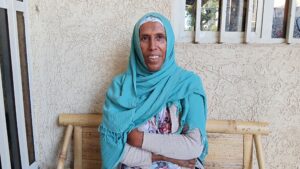
W/ro Birqe Yibre, a traditional bone-setter known locally as a Wogesha, sits in her residential courtyard in Bahir Dar, Ethiopia. She says she has practised for more than two decades. (Photo: Sleshi Teshome)
One of her patients, Yidersal Mengistu, came with a painful right foot and a bruised big toe after kicking a stone while playing football.
“I didn’t go to the hospital. To be honest, I prefer the traditional way,” Mengistu said. He explained that he had visited Birqe before for heel pain and believed her treatment had helped him. He also said she had treated him without charge on that earlier occasion.
“If I recover fully this time, I will pay her,” he said.
For Birqe, payment depends partly on what patients can afford. She said people who have money typically pay between 150 and 200 Ethiopian birr, while she treats those who cannot pay without charging them.
“If someone has no money, I treat them and tell them, ‘Go on, go home,’” she said. “You cannot turn away poor people.”
A study of 836 people with a history of injury in Mecha district, published in BMC Complementary Medicine and Therapies, found that 46.05 per cent had used traditional bone-setting services. Social acceptance was the most commonly reported reason for seeking this care. The findings reflect the study population in Mecha district and should not be taken as a national estimate.
For patients such as Mengistu, the decision is also shaped by personal experience and trust. But the treatment of fractures and other serious injuries can carry risks when patients delay seeking medical assessment.
Knowing When to Refer
Birqe said she distinguishes between injuries she believes she can treat and those that require hospital care.
“I handle muscle pulls and minor dislocations,” she said. “If someone comes with a serious, displaced bone or a deep fracture, I tell them plainly to go to the hospital. I don’t try to touch it.”
She said she was concerned about practitioners who accept serious cases despite lacking the necessary skills to manage them.
According to Birqe, some bone-setters bind injured limbs tightly with bamboo splints, locally known as Timaq, and continue treatment even when a patient’s condition worsens. She said some eventually advise patients to seek hospital care only after several visits.
“When parents bring me a child whose hand is already ruined, I tell them: ‘Run to the hospital, I won’t touch this,’” she said.
Her account highlights a distinction within traditional practice: while Birqe says she refers serious injuries, she believes other practitioners take on cases beyond their abilities. These claims describe her experience and observations; establishing how widespread such practices are would require further evidence.
A Crooked Arm
Thomas Habtamu, a student living in Bahir Dar, said a fall during a neighbourhood football match injured his left forearm. Because of his family’s financial difficulties, he did not go to a hospital and instead sought treatment from a local Wogesha.
“The healer kept massaging it week after week, telling me to be patient,” Habtamu recalled. He said the injury was close to the joint and that the treatment did not restore the arm to its normal position.
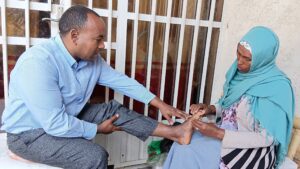
W/ro Birqe Yibre examines the injured foot and bruised big toe of Yidersal Mengistu in Bahir Dar. Mengistu said he injured his foot after kicking a stone while playing football and chose to seek traditional treatment. (Photo: Sleshi Teshome)
“He told me that if I ever fell down and hurt the arm again in the future, he might be able to reset it then,” Habtamu said.
Habtamu has never had the arm examined at a hospital. He said his forearm remains visibly bent and that he struggles with activities such as push-ups, lifting heavy objects and prolonged gym exercise.
He contrasted his experience with that of a friend who sustained a similar injury around the same time. According to Habtamu, his friend went to hospital, underwent an operation in which a metal plate was inserted, and recovered the use of his arm within about two months.
The two accounts illustrate the different experiences the men reported. Without medical records or an examination, however, the precise nature of Habtamu’s injury and the extent to which the treatment contributed to his current condition remain unconfirmed.
What Happens When Fractures Are Not Properly Treated?
At Tibebe Ghion Specialized Hospital in Bahir Dar, Dr Biruk Ferede, an orthopaedic specialist, said some patient’s mistake natural bone healing for proof that a traditional treatment has worked.
“An undisplaced fracture can heal naturally on its own; bone is living tissue that knits over time,” he said. He warned that manipulating a displaced fracture or an injured joint without appropriate assessment can cause further problems. One possible complication is malunion, in which a fractured bone heals in an incorrect position. Dr. Biruk said correcting such injuries can require more complex surgery than treating them soon after they occur.
He explained that surgeons may need to cut and realign a bone that has healed in the wrong position and secure it with plates. Stiffness in a nearby joint can make treatment more difficult, particularly when care has been delayed.
Dr. Biruk also raised concerns about tightly applied traditional splints, especially when used on children. Swelling around an injured limb can increase pressure beneath a tight binding and compromise blood circulation. Severe cases may result in permanent tissue damage.
He said children are particularly vulnerable because they may be unable to communicate the severity of their pain or remove a restrictive splint themselves.
“Children cry continuously, but parents may assume the crying is just normal pain,” he said. He described cases in which children arrived at hospital with severely damaged limbs and amputation was considered necessary.
Trust, Access and Medical Care
Dr. Biruk said social expectations can also influence treatment decisions. He recalled an incident involving a fifth-year medical student who sustained a fracture. According to the doctor, family members and neighbours took the student to a Wogesha before the student could decide where to seek care.
“If an educated medical student faces that kind of pressure, what do you expect from ordinary citizens?” he asked.
The incident, as recounted by Dr. Biruk, illustrates the influence that family and community expectations can have on decisions about treatment. It does not establish how frequently this happens, but it offers an example of how social pressure may affect an individual’s choices even when formal medical care is familiar to them.
Some health advocates have suggested providing traditional bone-setters with basic training to help them recognise serious injuries and refer patients to hospitals. Dr. Biruk is sceptical that short training can make practitioners safe to manage fractures.
“Becoming an orthopaedic surgeon requires years of medical education and specialist training,” he said. “You cannot turn someone into a safe trauma practitioner with short training.”
He argued that basic first-aid awareness should be available to the public, while suspected fractures and serious injuries should receive assessment from qualified medical professionals.
Birqe’s account, meanwhile, points to why some patients continue to seek help outside hospitals: she offers familiar care and says she does not turn away people who cannot pay. Habtamu’s experience shows why a patient’s decision about where to seek treatment can have lasting consequences.
Their stories do not establish that all traditional bone-setters practise in the same way, or that every patient who visits one will suffer complications. They do, however, raise questions about how people assess injuries, what influences their choices and how quickly they can access appropriate medical care.
For patients with suspected fractures, the challenge is to seek treatment that addresses the injury before complications develop. Understanding why people turn to traditional practitioners is part of that challenge, but so is ensuring that serious injuries receive timely medical attention.
Research published in the Journal of Bone and Joint Surgery examined amputations associated with traditional bone-setting in southern Ethiopia. During an initial two-year retrospective review, researchers recorded 49 amputations, 25 of which were associated with gangrene following tight splintage by traditional bone-setters. After instructional courses were provided to 112 traditional healers and local health assistants, a subsequent two-year prospective study recorded 25 amputations, including seven associated with gangrene. The author concluded that educating traditional healers could help reduce amputations caused by gangrene. However, the findings come from a specific setting and period and should not be treated as a measure of the prevalence of these complications across Ethiopia.
The post The Bone-Setters’ Ward: How Ancient Healers Are Filling Ethiopia’s Modern Healthcare Vacuum appeared first on African Arguments.