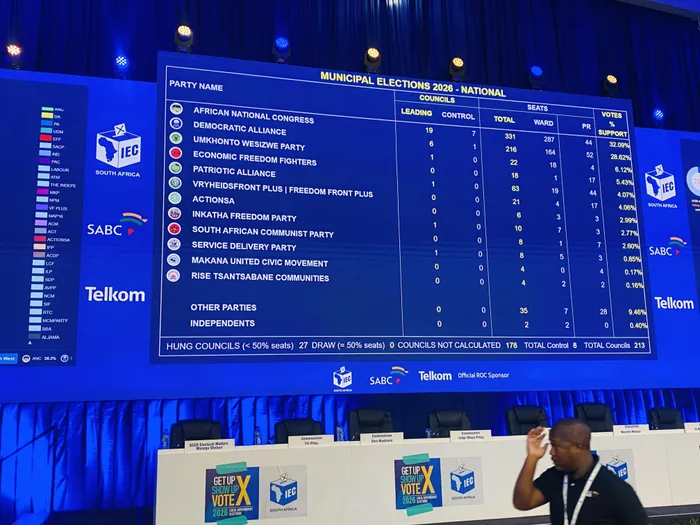
The IEC says 15.9 million South Africans participated in the 2026 local government elections so far.
The Electoral Commission of South Africa (IEC) says 15.9 million South Africans participated in the 2026 local government elections, while more than 800 complaints had been lodged by contestants by Wednesday night.
Deputy Chief Electoral Officer Masego Sheburi made the announcement during a media briefing on Thursday morning as vote counting continued and preliminary results began to emerge.
This comes after voting concluded across the country, with the counting process now under way.
Special voting took place on Monday and Tuesday, while general voting was held on Wednesday, November 4.
About 29.2 million registered voters were eligible to cast their ballots to elect local government representatives.
However, some voting stations across the country were still experiencing long queues on Wednesday night, prompting the IEC to extend voting arrangements to allow those already in line to cast their ballots.
Despite the commission describing voting as having progressed well nationally, the day was marred by delays caused by protests and heavy rain, the theft of election materials in eThekwini, power outages at some voting stations and the death of a woman who collapsed while waiting to vote in Durban.
IEC records more than 800 complaints
Sheburi said the overall participation rate would only be determined once the counting process had been completed.
“In other words, we know the total number of valid votes, the votes that are spoiled, and the votes that have been discarded,” he said.
“We can indicate that at this rate, 15.9 million South Africans participated both during special votes as well as during the elections yesterday.”
On complaints, Sheburi said just over 800 had been lodged by contestants by Wednesday night.
He said most complaints related to the conduct of voting station staff, including allegations that party agents had been prevented from observing the voting and counting processes.
“The majority of those objections were closed and determined. Only about 106 remained open,” he said.
Sheburi clarified that the 800 complaints referred to those lodged with the commission, while other objections were handled by presiding officers at individual voting stations.
He said contestants would also have an opportunity to raise objections that could have a material impact on the outcome of the declared results.
IEC sets deadline for objections
Sheburi said objections relating to the outcome of the elections had to be submitted by 5pm on Friday.
“These are dealt with by the commission. And once the commission has dealt with those objections, it will be in a position to indicate when it will announce the final result,” he said.
He added that the commission had seven days in which to declare the results, as provided for by law.
“The commission does not want to keep the country in angst, and for that reason, it will release the result as soon as all objections have been dealt with lawfully,” Sheburi said.
“The commission cannot release or declare the results before 17:00 tomorrow afternoon.”
Vote counting continues
Meanwhile, vote counting is continuing, with preliminary results gradually coming in.
At the time of writing, 25% of the votes had been counted nationally.
The IEC is expected to announce the final election results over the weekend, subject to the conclusion of the objections process.