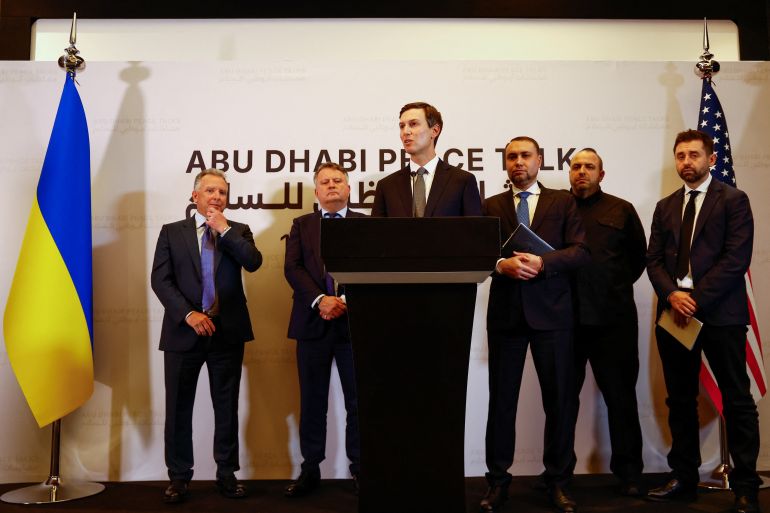
 US envoy Jared Kushner calls the talks in Abu Dhabi, UAE, 'productive', November 11, 2026 [Rula Rouhana/Reuters]
Two days of talks between Russian and Ukrainian officials, mediated by the United States, have yielded agreement on a prisoner exchange but failed to make a breakthrough on ending the war, which is nearing the five-year mark.
Russia’s chief negotiator, Vladimir Medinsky, said at the talks in the United Arab Emirates capital, Abu Dhabi, on Wednesday that both sides had agreed on a large-scale prisoner swap and that mutual understanding had been achieved on some issues.
Recommended Stories
Russia’s state-run news agency TASS reported that the prisoner exchange should happen in two to three weeks. If finalised, it would be the latest in a long line of such exchanges.
US envoy Jared Kushner told a news conference the number of prisoners would be finalised on Thursday. He added that he would travel to Moscow alongside US special envoy Steve Witkoff to relay what was discussed to Russian President Vladimir Putin and “make more progress on some of the issues that were discussed, because we see some openings and some opportunities there”.
Kushner and Witkoff are then scheduled to fly to Dublin, Ireland, to meet Ukrainian President Volodymyr Zelenskyy “and explore some of the ideas we came up with”.
Political analyst Dmitry Medvedenko told Al Jazeera that prisoner exchanges have been a regular occurrence without this level of diplomatic work. “Every two or three months you have 100 to 300 prisoners exchanged by both sides; this is a channel that actually works,” he said.
Ukraine and Russia freed 200 prisoners of war each in March following talks in Geneva, Switzerland, in February. Last year, they each exchanged 146 prisoners after mediation by the UAE, and large-scale prisoner exchanges followed three rounds of talks in Istanbul, Turkiye, from May to July.
“For it to be the biggest prisoner exchange, it should top the 1,000-for-1,000 exchange in May last year,” Medvedenko said.
The two warring sides entered Wednesday’s talks far apart on terms for a possible settlement to the war.
Kushner said it was “a long way to get everyone back to the table” and that “this was a very tough meeting but a productive one”. He added that territorial issues would be the hardest to settle but that “progress” was made on a post-war security framework.
More talks, EU presence uncertain
Medinsky said more talks would be held in the near future and that Moscow was not opposed to participation from the European Union. He added, however, that it was unclear what there was for Russia and the EU to discuss, given what he said was a lack of proposals from the European side.
Ukraine’s peace negotiator David Arakhamia said there was “good momentum” from peace talks in Abu Dhabi towards reaching a solution before the end of the year and that the next talks should be multilateral, not trilateral, adding that Europe should be represented.
Zelenskyy, who, like Putin, is not attending the talks, said on Wednesday he did not think it was possible to think about European security “without Europe”.
Kushner said further talks with the Russian and Ukrainian presidents would touch upon “whether we can get Europeans to the format and make this a multilateral format”.