
Shamiri Institute CEO Tom Osborn speaking on the Future of Africa at a past One Young World Summit.
As technology companies promote artificial-intelligence chatbots as alternatives to therapy, Kenyan social entrepreneur and Forbes 30 under 30 recipient Tom Osborn argues how AI can support counsellors, psychologists and psychiatrists rather than replace them.
He was speaking at the One Young World Summit, held at the Cape Town International Convention Centre from November 3 to 6.
Osborn, 30, is the founder and chief executive of the Nairobi-based Shamiri Institute, which works to expand mental-health support for young Africans.
Osborn said AI tools should not be used as standalone mental-health providers without rigorous evidence and safeguards.
The organisation’s Shamiri AI platform is designed to train lay providers, monitor clinical quality and support care referrals — not to operate as an automated therapist.
“Our project Shamiri AI is intentional in that we think AI is not yet ready to be used as a direct-to-consumer agent,” he said.
“Our thinking is, if we have to hold AI tools for mental health to the same standard as digital medical devices, that requires robust scientific inquiry to figure out if it’s actually productive.”
Personal experience
Born into a smallholder farming family in western Kenya, Osborn’s entry into the social entrepreneurship world was catalysed by a deeply personal family crisis.
At the age of 14, he earned a scholarship to a boarding school in Nairobi. During this time, his mother developed a severe respiratory infection from cooking with firewood—a common household hazard in rural Kenya.
Initially studying energy and economics to pursue clean-tech ambitions, Osborn experienced a profound shift during his second year at Harvard University.
An introductory psychology class provided the vocabulary to understand his own "unaddressed struggles with severe anxiety, bullying, and depression during high school."
Realising these challenges were widespread among his peers, he pivoted his focus to clinical psychology and mental health interventions.
Through his research at Harvard, Osborn identified a glaring paradox: Western nations spend the most on mental health care, yet often yield worse outcomes than developing nations.
He became a vocal critic of the global reliance on Western diagnostic frameworks like the DSM: "Our definition of mental health is pretty bad, if I’m being honest," Osborn noted.
"Basically, what happened was a few people came together in America and wrote the DSM, and then that’s been the standard. I think we pretty much all agree that it is not an accurate representation at all. It’s a broken foundation."
He also highlighted how the violent, institutionalised history of psychiatric care under African settler colonialism continues to fuel stigma around psychological treatment.
As a result, he advocates meeting people where they are rather than relying solely on clinical terminology.
“Depression is stigmatised,” he said, “but if you ask them, ‘Are you having trouble sleeping? Are you not motivated?’ these are human things that people are going through, and they already have their own ways of trying to deal with that.”
How Shamiri AI supports counsellors
Osborn said Shamiri AI is used in three main areas.
“Software is just like one medical intervention point within a broader care system,” he said. “We’re a little bit on the cautious side when it comes to direct-to-consumer access.”
He said automated triage should help identify high-risk cases and refer them to qualified practitioners.
Privacy, consent and research
The use of mental-health conversations to develop or assess AI systems raises significant privacy and ethical concerns.
“A lot of the AI work, especially on the continent, has been built on the, for lack of a better word, exploitation of people’s data,” Osborn said. “Walking in a health space, and especially in a mental-health space, you have to lead with data privacy and ethics.”
He said Shamiri limits the data used for machine-learning research to controlled scientific studies rather than commercial scraping.
“All of the data that we have, we have in the context of randomised research trials rather than in the context of our routine care,” Osborn said.
According to Osborn, the data is anonymised and stored on servers in Kenya, with oversight from local health authorities and an ethics review board.
The organisation records and transcribes some sessions to study what contributes to recovery during talk therapy.
“Because it is talk therapy, you need to collect not just the client outcome data, but you also need to collect the content of the sessions of the talk,” he said.
The research is intended to examine how much improvement is linked to the relationship between a client and provider, and how much is linked to the specific therapeutic intervention.
“If you go to see a therapist, part of the question is, how much of that effect is driven by the interpersonal connection and conversational skills of the person?” Osborn said. “And how much of it is driven by what they call the active ingredient?”
He said how these findings could influence how Shamiri trains and supervises its providers.
“If it’s more of the latter, then you’re making a case that actually when you’re training providers, you need to prioritise this interpersonal connection,” he said.

Challenging diagnostic conventions
Osborn questioned whether diagnostic systems developed in the United States can adequately reflect experiences across different cultures.
“Our definition of mental health is pretty bad, if I’m being honest,” Osborn said. “Basically, what happened was a few people came together in America and wrote the DSM, and then that’s been the standard.”
“I think we pretty much all agree that it is not an accurate representation at all. It’s a broken foundation.”
In Kenya, psychiatric labels can carry stigma and historical associations, Osborn said. Shamiri uses measures of depression and anxiety in clinical trials because standardised measures are required for research and academic publication.
“Depression is stigmatised,” he said. “But if you ask them, ‘Are you having trouble sleeping? Are you not motivated?’ these are human things that people are going through, and they already have their own ways of trying to deal with that.”
Shamiri therefore uses less clinical language when working with communities, focusing on people’s experiences and practical difficulties rather than leading with diagnostic labels.
Osborn said this approach could make it easier for young people to seek support without feeling that they had been defined by a psychiatric diagnosis.
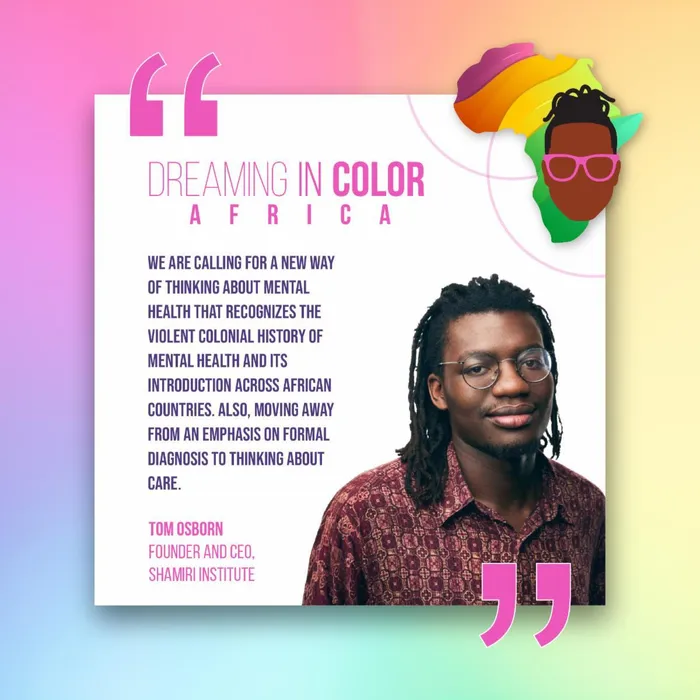
"Moving away from an emphasis on formal diagnosis to thinking about care." — Tom Osborn, founder and CEO of the Shamiri Institute, calling for a reimagined approach to mental health in Africa.
Expansion through support
Osborn said Shamiri had reached 250,000 young people and aimed to reach 1 million participants by the end of 2027 and 10 million by 2031.
The organisation is increasingly seeking government partnerships rather than relying mainly on private-sector funding or other non-governmental organisations.
“To get to this scale, who is our partner at scale?” Osborn asked. “We’re increasingly realising that to have this impact, we need to work with the government.”
For Osborn, the role of technology is to provide support, supervision and triage while leaving care in human hands.
“We don’t really need to institutionalise all aspects of mental health,” he said. “Technology must empower communities to support their own.”
For Osborn, technology should support mental-health workers by helping them train, maintain quality and connect people with appropriate care. It should not take the place of human judgement, trust and accountability.