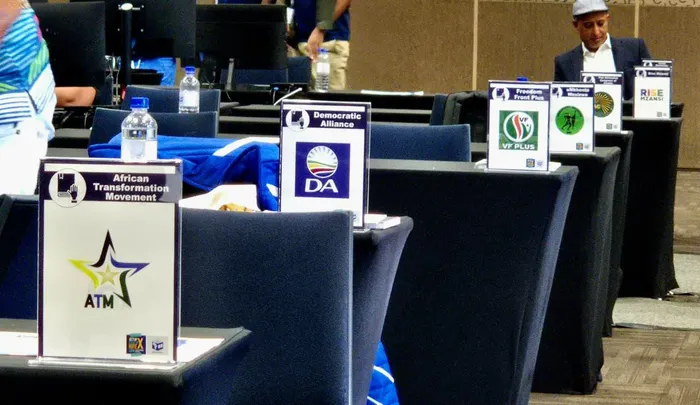
The election results have left 69 of the 100 councils decided so far without an outright winner
Horse-trading for control of SA’s councils is set to begin in earnest, with hung councils outnumbering outright wins by more than two to one as the count passed 63% on Thursday night.
Of the 100 councils decided by 11pm, 69 had no outright winner, leaving smaller parties holding the keys to power in dozens of municipalities.
The ANC had won 21 councils outright, the DA six and the MK Party three, with 113 still to be calculated.
Nationally, the ANC was on 31.65%, the DA on 25.25% and the MK Party on 8.48%, on course for the ANC’s worst showing in any election since 1994.
Political analyst Prof André Duvenhage said the vote had redrawn the country’s political map.
“The 2026 election is a watershed, and the most prominent feature is the support base of the ANC dropping to around 32%,” Duvenhage told IOL on Thursday night.
He said ActionSA had emerged as the surprise package of the election and was likely to be a major player in coalition talks.
“The rising star of this election is ActionSA.
"They are performing extremely well, especially in some of the urban areas."
The EFF polled 6.03%, followed by the IFP on 4.57%, ActionSA on 4.56%, the FF Plus on 3.36%, the SACP on 2.55% and the PA on 2.54%.
The SACP’s result marked a break with decades of electoral alignment with the ANC, having contested the local government elections under its own banner for the first time instead of relying on its alliance partner to contest the polls.
For the second election running, a lone voter in Orania, the Afrikaner enclave in the Northern Cape, backed the EFF.
At the Vluytjeskraal Farm voting district in the town, the FF Plus won 204 votes and the DA 23, with the EFF and the PA picking up one vote each.
In 2024, a single EFF vote at Orania Volkskool also tickled South Africans pink.
The battle for the metros will be fought almost entirely at the bargaining table.
In Johannesburg, the DA had 40.61% with 38% of the votes counted, while the ANC and ActionSA were locked in a scrap for second place on 16.64% and 15.94%.
In Tshwane, the DA was on 34.86%, ActionSA on 22.16% and the ANC on 20.18%, with 55% of the votes counted.
In Ekurhuleni, the DA had 31.66%, the ANC 21.3% and ActionSA 17.94%.
Duvenhage said Tshwane had split into three large blocs, with the DA, the ANC and ActionSA each a force to be reckoned with.
ActionSA’s Matthew George made it clear the party intended to be the kingmaker.
“In Tshwane, in Ekurhuleni, in Joburg, residents can expect to see ActionSA being at the centre of any coalition formations that are taking place in this province,” George said.
He said any partner would have to commit to tackling illegal immigration and corruption and to delivering services fairly.
Outside the metros, the DA made deep inroads into Emfuleni, which takes in Vereeniging and Vanderbijlpark, where it was on 49.12%, and extended its grip on Midvaal with 63.61%.
In KwaZulu-Natal, the MK Party was out in front on 33.88% with 57% of the votes counted, with the IFP on 23.74% and the ANC on 22.27%.
The MK Party had won three councils outright in its first local government elections, Richmond, iMpendle and Johannes Phumani Pungula, and was the biggest party in five more.
In eThekwini, the MK Party had 42.95% of the votes counted so far, with the DA on 21.02%, the ANC on 16.56% and the IFP on 9.2%.
The DA was ahead in Msunduzi, home to the provincial capital, Pietermaritzburg, on 37.52%, with the MK Party on 29.05% and the ANC on just 13.81%.
MK Party spokesperson Sifiso Mahlangu said the party would not trade its principles for positions.
“We will only go in with parties that believe what we believe,” Mahlangu said.
In the Eastern Cape, the home province of Nelson Mandela and Oliver Tambo, the ANC was held below half of the vote on 46.83% with 73% of the votes counted.
The DA was on 18.2%, the SACP, contesting the elections separately from its long-time ally, on 6.14%, the UDM on 5.99% and the EFF on 5.84%.
The ANC had won seven councils in the province outright, while the DA kept Kouga with 58.55%.
The UDM’s best results came in Mbhashe, where it had 24.49%, Buffalo City on 18.3%, Kumkani Mhlontlo on 16.55% and King Sabata Dalindyebo on 15.58%.
The UDM’s Yongama Zigebe said the party was riding a wave of support on the ground.
“UDM is the talk of the town. Even wearing a t-shirt of the UDM these days, you must hide the logo if you don’t want anyone asking for a t-shirt,” Zigebe said.
He said the party had not spoken to anyone about coalitions and would wait for the final results.
“We don’t have anyone we are not going to talk to. We have not spoken to anyone,” Zigebe said.
He said clean governance and the fight against corruption and wasteful spending would be non-negotiable in any deal.
“It’s not about positions. It has to be about the people first,” he said.
On the UDM’s seat in the Government of National Unity (GNU) alongside the ANC, Zigebe said the party kept its national and local politics apart.
“Nationally we sit in the GNU, but on a municipal level we are competing. As a party we always fight to maintain our autonomy from any arrangements that we get into,” he said.
Zigebe said the UDM had asked for a recount in Ward 1 in King Sabata Dalindyebo after its agents were unhappy with how the count was handled, and the matter had been escalated after the request was turned down at the station.
In King Sabata Dalindyebo, which takes in Mthatha, the ANC was on 42.58% with 55% of the votes counted, with the UDM second, the SACP on 9.42% and the ATM on 9.36%.
In the Northern Cape, with 99% of the votes counted, 17 of the province’s 26 councils were hung.
The ANC was on 41.56%, the DA on 21.72%, the EFF on 9.16% and the PA on 8.42%, with the ANC winning seven councils outright.
In Sol Plaatje, which takes in Kimberley, the ANC was the biggest party on 37.93% but well short of a majority.
In Limpopo, the ANC held a comfortable lead on 54.21% with 42% of the votes counted, with the EFF on 10.6% and the DA on 9.23%.
In the Western Cape, the IEC’s provincial electoral head, Michael Hendrickse, said counting at voting stations was done and the results were being captured.
“They are going through verification and auditing. That is the process we are currently at in our province,” Hendrickse said.
Just after midday, 65% of the 4,040 result slips expected in the province had been captured and audited, with Cape Town expected to be among the last municipalities to be finalised.
Cape Town appeared set to be the only metro to avoid coalition politics, with the DA already claiming an outright majority.
FF Plus Western Cape deputy chairperson Grant Marais said voters had sent a clear message to every party.
“There is no single political party that the electorate is trusting at the moment," he said.
"They want coalitions, they want representation."
He said the FF Plus had won seats in Knysna and Bergrivier for the first time.
ANC Western Cape head of mobilisation Thando Dedezane said turnout in townships was only about 31%, which he blamed partly on confusion over which sphere of government was responsible for services.
DA leader Geordin Hill-Lewis made no secret of his dislike of coalitions, pointing to the turmoil in Johannesburg and Tshwane.
“Coalitions bring chaos. They’re not the best outcome for the public,” Hill-Lewis said.
The FF Plus’s Peter de Necker said corruption would be a dealbreaker in any talks.
“If a party is not prepared to renounce corrupt activities, to deal with corrupt officials, then obviously we will be lying to our voters,” De Necker said.
The ANC was keeping its cards close to its chest, with first deputy secretary-general Nomvula Mokonyane saying the party would wait for a mandate from its national leadership before making any decisions.
She conceded that water shortages and uncollected rubbish in areas the ANC has long dominated had driven some voters away.
Political analyst Dr Levy Ndou said the sheer number of parties on the ballot had split the vote, making hung councils almost inevitable.
“There is an abundance of political parties in South Africa, and that is why citizens are spoiled for choice,” Ndou said.
He said the real test would be whether politicians could work together without bringing services to a standstill.
Middle East Africa Research Institute research fellow Kenneth Kgwadi said coalitions had left a bad taste across the country.
“We’ve had the bad taste of coalition politics in South Africa where parties do as they please because they are not governed,” Kgwadi said.
Political analyst Dr Oscar van Heerden said the ANC had one last chance to recover before the 2029 general elections.
“Let us hope there will be a phoenix from the ashes in 2029,” Van Heerden said.
Voting and counting were marred by several incidents.
In Douglas in the Northern Cape, members of a political party stormed the counting station at Bongani Community Hall and tore at least 100 ballot papers.
“Not only did they storm the counting station, they laid siege to it,” IEC deputy CEO Masego Sheburi said.
He said the commission would decide how the votes at the station should be treated and what consequences the party should face.
In eThekwini, unused ballot papers and a stamp meant for special voting were stolen from a voting station, and staff there were relieved of their duties.
In Polokwane, a 31-year-old man believed to be an EFF member was stabbed to death in a park opposite the Flora Park Comprehensive School voting station, and a 35-year-old man was arrested.
In Shallcross, south of Durban, a woman in her late 60s died at the Shallcross Primary School voting station, with the IEC saying it was establishing what had happened.
In Madlalisa in the Eastern Cape, about 400 protesters carrying “No vote” placards gathered at a voting station.
Prof Joanna Botha, a public law expert at Nelson Mandela University, said the Electoral Code of Conduct barred parties and candidates from using language that provoked violence or intimidated voters, candidates or rival supporters.
She said breaking the code could carry a sentence of up to 10 years in prison, while parties could be fined up to R200,000.
Botha said that, after the attack on North West farmer Donovan Marx, whose ears were sliced off, the singing of “Kill the Boer” at an EFF rally in Soweto days before the vote could be challenged.
“I think a case could be made to show that the singing of the song on the occasion in issue is, at the very least, intimidatory and thus falls foul of the Code,” Botha said.
The Supreme Court of Appeal ruled in 2024 that the song, sung at EFF rallies, was political expression rather than hate speech.
IEC chairperson Mosotho Moepya said on Thursday evening that the commission expected to finish collating the results by the weekend, but warned that the figures were provisional until objections had been finalised.