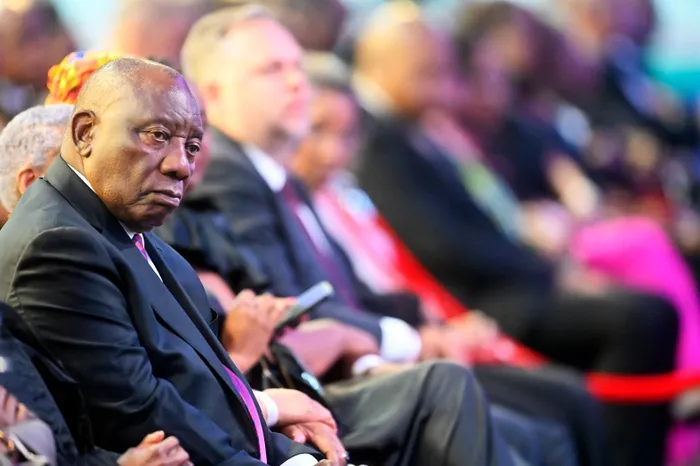
The 2026 local government elections have reshaped South Africa’s political landscape, with the ANC losing ground, the DA leading in five metros and coalition negotiations set to determine who governs several key cities.
South Africa’s political landscape has shifted following the 2026 Local Government Elections, with the African National Congress (ANC) retaining its position as the country’s biggest party nationally but suffering further electoral setbacks, while the Democratic Alliance (DA) emerged as the leading party in five of the country’s eight metropolitan municipalities.
The results have set the stage for potentially complex coalition negotiations in several major cities, with smaller parties such as ActionSA emerging as influential players in Gauteng and the uMkhonto weSizwe (MK) Party consolidating its position in KwaZulu-Natal.
With no single party securing an outright majority in seven of the eight metros, the focus now turns to negotiations that will determine who governs some of South Africa’s most important urban centres.
The ANC secured 30.76% of the national vote, followed by the DA on 24.64%. The MK Party came third with 9.76%, ahead of the Economic Freedom Fighters (EFF) on 6.22% and ActionSA on 5.67%.
The results represent another significant test for the governing party, whose support has declined in successive elections amid growing frustration over municipal service delivery and political instability.
Nationally, approximately 14.9 million South Africans cast their ballots, representing a voter turnout of 52% – an increase of 6.1 percentage points from the 45.9% recorded in the 2021 Local Government Elections.
DA leads in five metros as coalition negotiations loom
The DA emerged as the leading party in Cape Town, Johannesburg, Tshwane, Ekurhuleni and Nelson Mandela Bay, while the ANC led in Buffalo City and Mangaung. The MK Party topped the poll in eThekwini.
Cape Town was the only metro where a party secured an outright council-seat majority, leaving the other seven facing coalition negotiations.
In Johannesburg, the DA finished ahead with 34.8% of the vote, followed by the ANC on 20.3% and ActionSA on 16.3%.
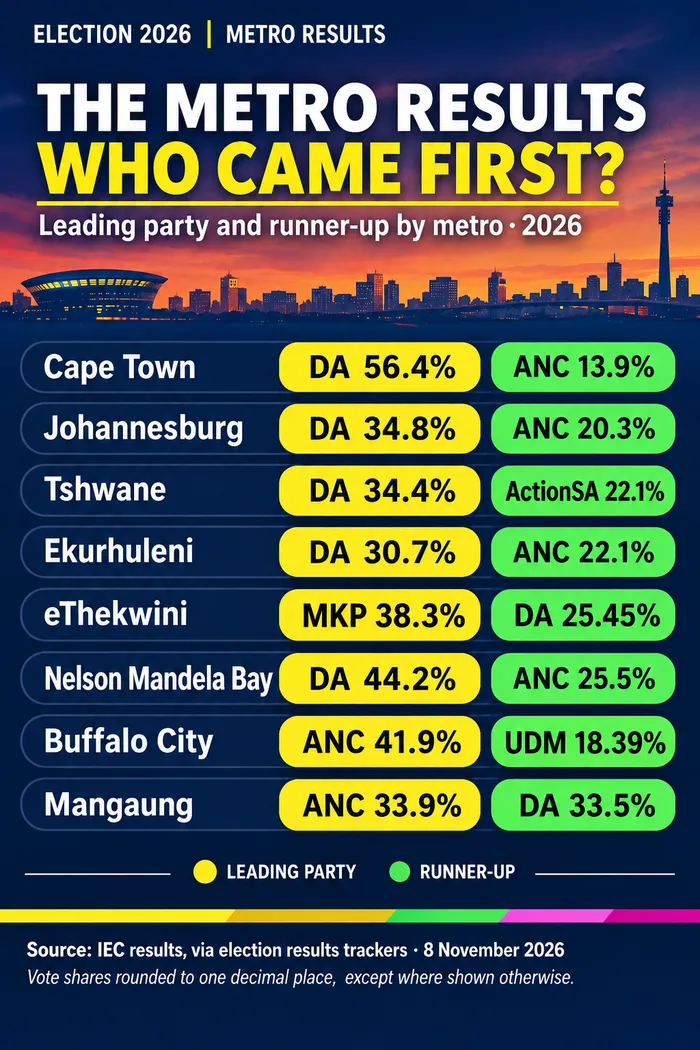
The DA's result represents a substantial improvement on its 26.1% share in 2021, while the ANC fell from 33.6%. ActionSA maintained a significant presence in the city, positioning itself as an important player in discussions about the next administration.
Johannesburg's 270-seat council requires 136 seats for a majority. Preliminary allocations put the DA on 91 seats and ActionSA on 43, leaving the two parties just short of the numbers needed to govern together.
The negotiations are already attracting attention following reports that ActionSA wanted the DA to reconsider Helen Zille's candidacy for Johannesburg mayor, with party leader Herman Mashaba reportedly being proposed for the position.
Mashaba has publicly challenged the Sunday Times report, accusing the publication of misleading its readers. ActionSA leader Michael Beaumont has indicated that the party is not ruling out an arrangement involving Zille, although it has reservations about her suitability.
Zille, meanwhile, has indicated that she would favour a two-party coalition with either ActionSA or the ANC, arguing that fewer coalition partners would make an administration easier to manage.
ActionSA has also completed its first round of coalition discussions with the ANC, which it described as productive and respectful.
In Tshwane, the DA led with 34.4%, with ActionSA second on 22.1%, while Ekurhuleni also saw the DA emerge as the leading party with 30.7%.
The DA secured 44.2% in Nelson Mandela Bay, while the ANC led in Buffalo City with 41.9% and Mangaung with 33.9%. In Mangaung, the DA was close behind on 33.5%.
The most significant shift in KwaZulu-Natal was in eThekwini, where the MK Party emerged as the biggest party with 86 of the metro's 223 council seats.
However, the party fell short of the 112 seats required for an outright majority. The DA secured 57 seats, followed by the ANC with 37, the Inkatha Freedom Party (IFP) with 15, ActionSA with seven and the EFF with four.
The outcome represents a major change in the political landscape of the metro, where the ANC previously held the largest share of council representation.
Ramaphosa tells councillors to put service delivery ahead of power struggles
Addressing the nation following the announcement of the election results at the IEC's National Results Operations Centre in Midrand on Sunday, Ramaphosa urged incoming councillors to put communities first and avoid allowing political power struggles to undermine service delivery.
He said the elections had demonstrated the strength of South Africa's multi-party democracy, with more than 540 political parties and nearly 137,000 candidates participating.
However, he said the real test would be whether those elected could improve the daily lives of ordinary South Africans.
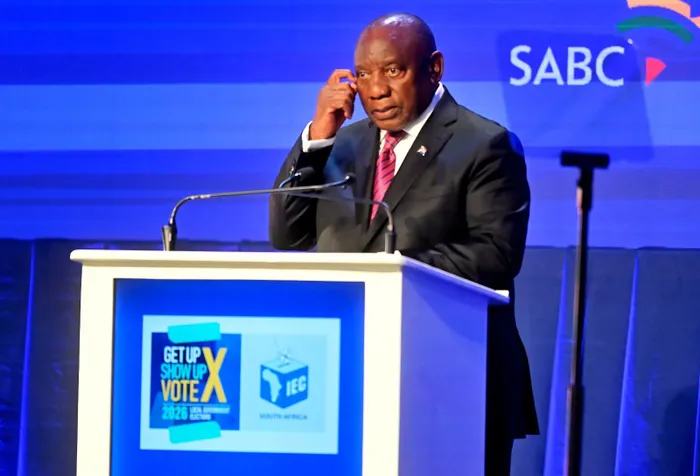
President Cyril Ramaphosa has urged incoming councillors to put service delivery ahead of political power struggles, calling for mature coalition negotiations and a focus on residents’ needs.
Ramaphosa acknowledged that households were facing serious social and economic pressures, with the rising cost of living and unemployment continuing to affect millions, particularly young people.
He said residents wanted functioning municipalities where water flowed from taps, electricity supplies remained reliable, refuse was collected, infrastructure was maintained and neighbourhoods were safe.
“These are not unreasonable expectations. They are the basic requirements of a life of dignity,” he said.
The President also urged political parties to approach coalition negotiations with maturity and humility, warning against treating municipal positions and privileges as the primary objective.
He said political parties needed to ensure that councils were constituted without unnecessary delays, office-bearers were elected through good-faith negotiations and municipal budgets were passed on time.
“This is not a weakness of democracy. It is an expression of the choices that the people have made,” he said.
Ramaphosa warned that essential service delivery should never become a bargaining tool in coalition negotiations.
Voters, he said, had not gone to the polls to give elected representatives another five years of fighting among themselves. Instead, they expected functioning councils, capable administrations and leadership that could rise above political differences.
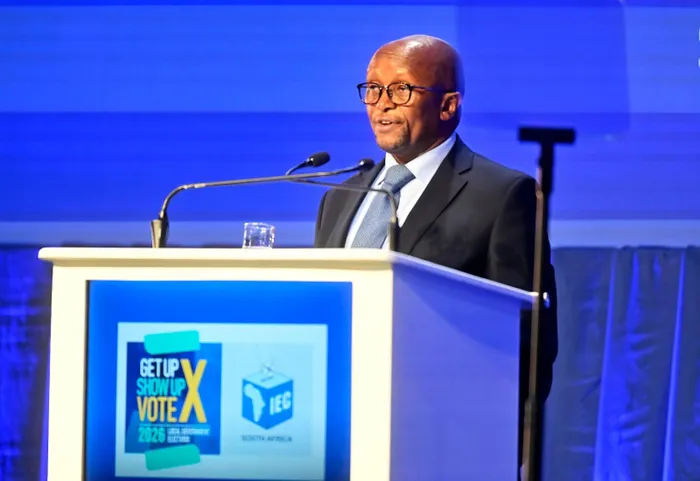
IEC chairperson Mosotho Moepya announces the final results of the 2026 Local Government Elections at the National Results Operations Centre in Midrand.
IEC declares elections free and fair despite operational challenges
The IEC has declared the 2026 Local Government Elections free and fair, while acknowledging that the process was not without shortcomings.
Chief Electoral Officer Sy Mamabolo said the commission had delivered the elections through extensive operational planning, technological improvements and the deployment of thousands of election officials across the country.
Approximately 188,000 electoral staff were deployed across 23,696 voting stations, with 15.2 million South Africans participating in the elections, according to Mamabolo.
He acknowledged that the commission had not got everything right.
“The 2026 local government elections were an unreserved endeavour to affirm the personhood of all voters. We have succeeded in many aspects in this election but we have come short in others,” he said.
Among the logistical challenges was a Constitutional Court order handed down on October 15, which required changes to candidate lists and resulted in approximately 28 million ballot papers being superseded.
The order related to 181 ANC candidates in six municipalities, but the IEC extended the same dispensation to 32 other political parties in similar circumstances.
Mamabolo said the changes required additional printing, quality assurance, packaging and distribution arrangements within an already established election timetable.
The commission printed just over 100 million ballot papers and deployed approximately 56,000 voter management devices to support voting station operations.
IEC chairperson Mosotho Moepya said the commission had dealt with objections during the electoral process but remained prepared to adjudicate further objections after the declaration, as provided for under Section 65 of the Local Government Municipal Electoral Act.
“No institution can take itself seriously if it does not acknowledge its shortcomings,” he said.
The commission also confirmed that it would arrange a re-election at an affected voting station in Douglas, in the Northern Cape's Siyancuma Municipality, after political activists allegedly stormed the station and destroyed ballot papers before they could be counted.
KZN results could still change as IEC considers objections
While the national results announcement marked a major milestone in the electoral process, KwaZulu-Natal's preliminary results could still change as the IEC considers late objections.
Provincial electoral officer Ntombifuthi Masinga said the commission was considering objections submitted after the prescribed deadline under Section 65 of the Municipal Electoral Act.
The commission must decide whether to reject the objections or condone their late submission before finalising the affected results.
Masinga warned that the objections could have implications at voting station, ward and municipal level.
“It is important to announce that the results that we are announcing today are preliminary results subject to the consideration of some of the Section 65s that were submitted late,” she said.
She cautioned political parties and the public against treating the current figures as final.
“Don’t be surprised if there is a slight change in some of the results given that we do not know the outcome of the Section 65 objections that were submitted late and may still be condoned by the Electoral Commission,” she said.
Masinga said the seven-day period for the commission to programme the results would expire on Wednesday, November 11. KwaZulu-Natal accounted for 11% of all Section 65 objections submitted nationally.
The province recorded a voter turnout of 49%, a few percentage points above the national average, and a spoiled ballot rate of 1.45%.
The IEC dismissed 25 temporary election staff members during the election period for various breaches, including displaying partisan behaviour at voting stations and failing to comply with the electoral framework.
However, Masinga said none of the province's 5,028 voting stations had run out of ballot papers, despite the logistical demands of the election.
The province deployed more than 40,000 election staff and administered more than 200,000 special votes, accounting for 18% of the national total.